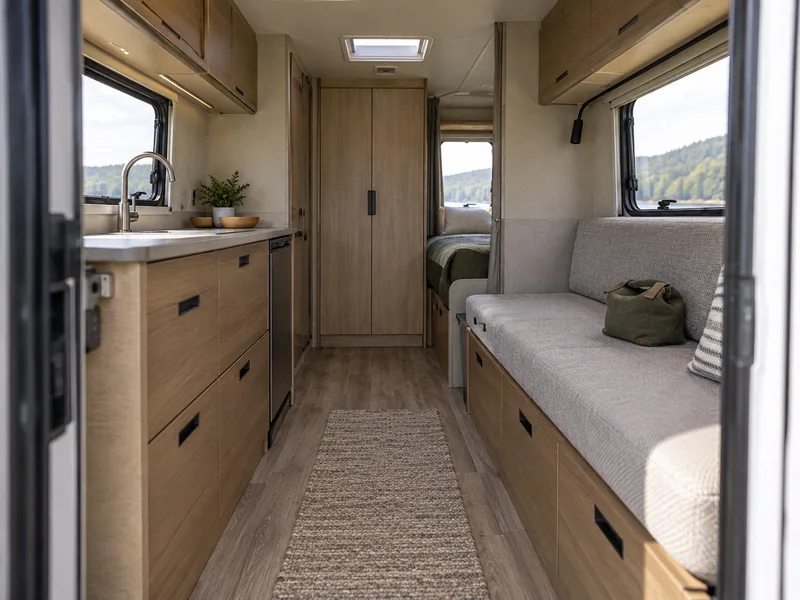
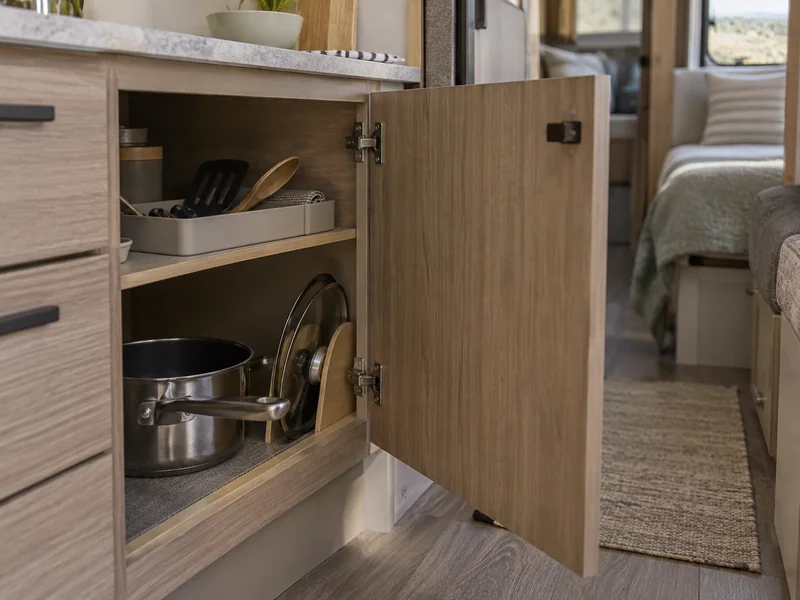
How to Choose an RV Vacuum for Floors, Seats, and Storage
Choose an RV vacuum by floor type, storage space, charging access, and maintenance. Compare published specifications and use a practical checklist before buying.
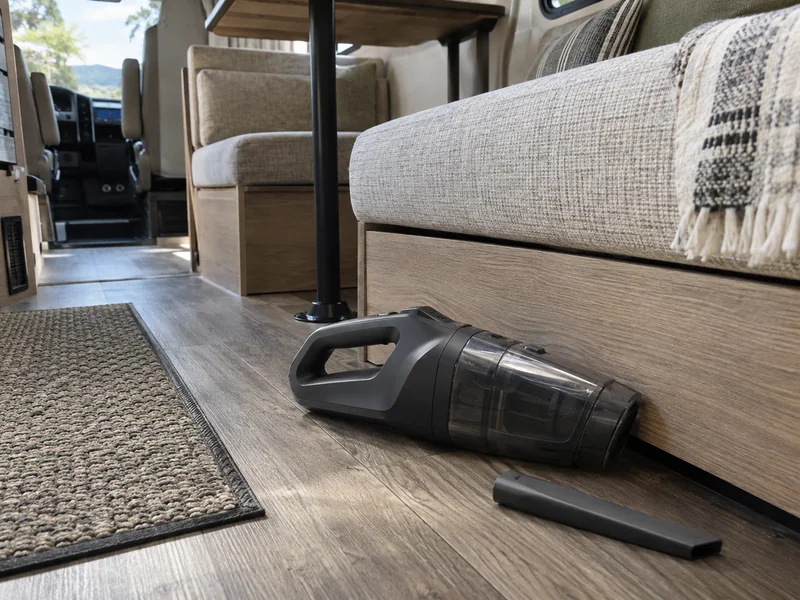
AI-generated illustration: different RV surfaces create different cleaning and reach requirements.
Choose an RV vacuum around the surfaces you need to clean, the position you can comfortably work in, and the storage and charging space available. Published dimensions and bin capacity can narrow a shortlist, but they do not establish debris pickup, pet-hair performance or real runtime in your RV. This researched guide compares two identifiable handheld models as specification examples and provides a worksheet for checking your own shortlist.
The best RV vacuum for your routine has to do two jobs: reach the mess and fit somewhere sensible afterward. A compact handheld might suit crumbs around a dinette yet be awkward for a whole carpeted floor. A longer floor-cleaning tool might solve that problem while creating a storage problem of its own.
Start with the work you need done, then compare the equipment. This is a researched selection guide, not a hands-on vacuum review. We have not measured pickup, noise, runtime or long-term reliability, and we do not name a tested winner. Two current manufacturer listings below show which specifications can help a shortlist and which questions they leave unanswered.
List the surfaces before choosing a vacuum shape
Walk through the RV and record where cleaning actually happens. Separate a hard kitchen floor from upholstery, entrance mats and narrow seat gaps. Note whether the area can be reached standing up or requires bending, kneeling or moving furniture.
Write down the material you expect to remove. Ordinary dry crumbs, tracked-in grit and hair caught in fabric are different tasks. Check the vacuum and surface manufacturers’ instructions for compatibility. Do not assume a household vacuum is suitable for liquids, hot material, hazardous dust or renovation debris.
Then decide whether a vacuum is needed for every task. An appropriate brush or other surface-compatible cleaning tool may cover a small hard-floor area without charging or filter care. Keeping a simple tool alongside a vacuum can be reasonable if the jobs are different; carrying several tools for the same occasional task deserves another look.
| Main job | Feature or arrangement to investigate | What published specifications cannot establish |
|---|---|---|
| Dry crumbs near a dinette | Reachable nozzle and a bin that is straightforward to empty | How many passes your particular crumbs and surface require |
| Narrow seat or cabinet gaps | Crevice-tool shape and the complete body clearance | Whether the tool reaches behind your actual obstruction |
| Larger hard-floor area | Floor attachment and a working position you can sustain | Comfort, steering and debris pickup across the whole floor |
| Hair on upholstery | Manufacturer-approved upholstery tool for that fabric | Hair removal on your seat covering without a relevant test |
| Entry mat | Suitable head and compatibility with the mat | Whether the mat moves, bunches or clogs the head |
| Quick cleanup between travel stops | Accessible storage and an available power arrangement | Whether the full routine is convenient enough to use regularly |
Choose the two jobs that matter most. A shortlist built around every possible mess can become much larger than the cleaning problem.
Compare complete tools, not battery-voltage labels
Handheld models put the motor and bin in your hand. That can simplify small, reachable jobs, but check the position required for low floors or distant corners. A stick-style arrangement can change the working reach while adding length, attachments and storage requirements. A corded option removes one battery-charging question but still needs a suitable electrical supply and a manageable cord route.
Battery voltage alone is not a cleaning-performance measurement. Neither is the size of the dustbin. Treat the manufacturer’s description as a source of candidate features, then ask what evidence would establish that the tool solves your specific task.
The relevant comparison may be as simple as whether a nozzle and your hand can reach the gap beside the dinette. A high specification elsewhere does not compensate for a body that hits the seat before the tool reaches the debris.
Two handheld specification examples
The table uses the US manufacturer listings for BLACK+DECKER CHV1410L and BLACK+DECKER BDH2000PL, checked September 11, 2026. These are two examples from one manufacturer, not a survey of the market or an endorsement of one brand.
| Published field | CHV1410L | BDH2000PL | How to use the information |
|---|---|---|---|
| Product weight | 2.6 lb | 3 lb | Start a handling comparison; weight alone does not describe balance |
| Listed length | 17.2 in | 7.5 in | Check the listed orientation before comparing a shelf |
| Listed width | 5.5 in | 6.2 in | Allow for your cabinet opening and handling room |
| Listed height | 7.7 in | 11.9 in | Do not assume the product fits with its charger attached |
| Dustbin capacity | 605 mL | 466 mL | Compare nominal capacity, not a measured number of cleanups |
| Listed replacement filter | VF110FC | PVF110 | Verify compatibility for the exact model before ordering |
The CHV1410L listing describes an extendable crevice tool and flip-up brush. The BDH2000PL listing describes a pivoting nozzle, built-in tools and a charging base. Those differences suggest reach and storage questions to investigate. They do not establish that either model cleans an RV better.
The listed dimensions are separate manufacturer fields. The pages do not provide a complete RV storage drawing with the charger, cable clearance, hand access and all possible nozzle positions. Do not multiply the three numbers into a volume and treat the result as a guaranteed storage requirement.
Both pages also publish runtime information, but this guide does not convert those claims into a whole-RV cleaning promise. The listings do not supply the common RV test conditions needed to compare pickup and runtime together. A longer advertised duration is not useful if the tool cannot complete the particular cleaning job.
Measure the opening as well as the storage space
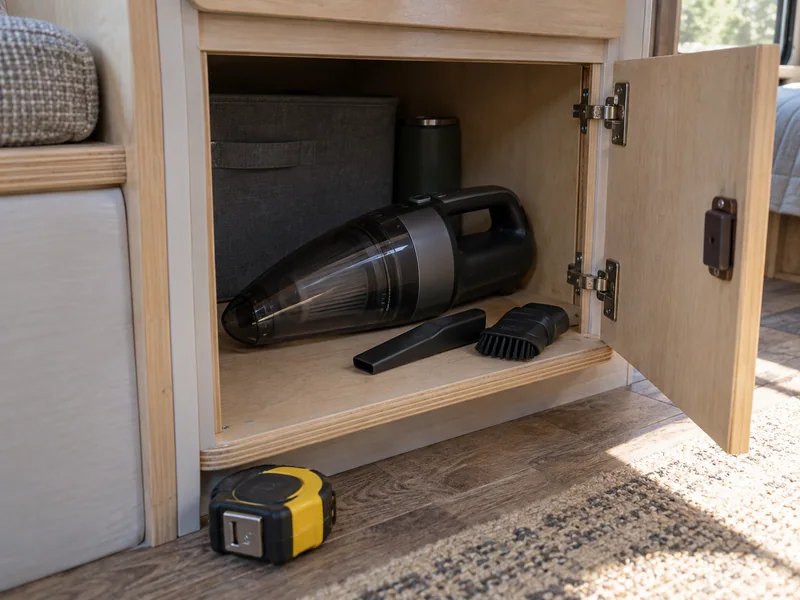
An empty shelf can be wider than its door opening. Measure both, and account for hinges, latches and anything the vacuum must pass on its way in. Decide which orientation you would actually use and whether a person can remove the tool without unloading neighboring items.
Lay out the complete kit: vacuum, charger, attachments, approved spare filter and any storage case. Record which pieces stay attached and which need separate homes. A small main unit with several loose accessories may take more organizing than a slightly larger unit with suitable onboard tools.
The RV storage planning guide helps assign the kit to a usable zone. If the only available space is in a kitchen cabinet, use the RV kitchen storage guide to keep cleaning equipment separate from food and clean serving items.
Storage during travel needs its own decision. Follow the RV and product instructions and choose appropriate retention for the actual location. A place where the vacuum balances while parked is not automatically a suitable place while the vehicle moves. Do not add a permanent mount without checking the surface, fasteners, equipment instructions and any restrictions that apply to the RV.
Check charging access before buying a cordless model
Find the exact charging instructions and charger information for the model under consideration. Check the permitted supply, charging conditions and whether its base must remain in a particular position. Do not assume that a household charger can connect directly to an RV’s battery system because both products involve batteries.
Choose a charging location that satisfies the product instructions, remains accessible and does not create a cord across a walkway. Think about when the supply is available. A tool that can only recharge conveniently on a day you are not connected to that supply may be a poor fit for the routine.
Use the camping power budget to account for the charging energy alongside other devices. Keep energy consumption separate from electrical compatibility. An energy estimate cannot establish whether an outlet, inverter or connection is appropriate.
If you already own a suitable vacuum, review this arrangement before replacing it. The missing solution may be a reachable storage location or a realistic charging schedule rather than another appliance.
Include filter care and emptying in the comparison
Find out how the bin opens and where you would empty it. Check whether the action is comfortable for the person using it and whether the waste can be contained without spreading debris around the occupied space. The bin’s nominal size does not tell you how pleasant the emptying process will be.
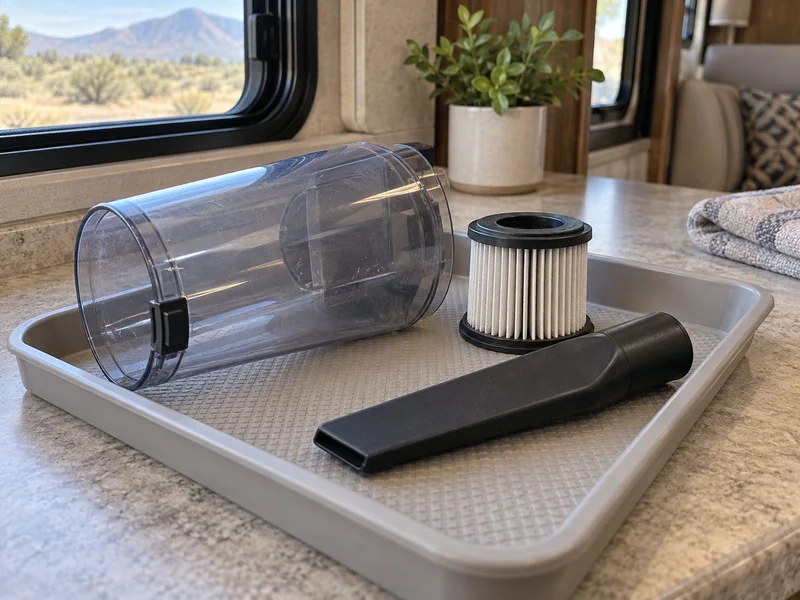
Read the exact filter-cleaning instructions. A listing that says a component is washable is not permission to wash the motor assembly or every part of the unit. Follow the manufacturer’s method, drying requirements and replacement guidance. Plan where cleaned components could dry under those requirements before needing the vacuum again.
Check replacement-part availability for the exact model rather than the product family name. Similar-looking filters can have different part numbers. Record a verified part identifier with the manual, and confirm current compatibility when purchasing a replacement.
Also check the warranty terms, service route and seller’s current return conditions. Keep those separate from your assessment of cleaning performance. A written warranty is not evidence that a product has completed a long-term durability test in an RV.
Use a shortlist worksheet without inventing scores
Fill in the rows using manufacturer documents, your own measurements and observations that you actually make. Mark unanswered questions as unknown. Do not replace an unknown pickup result with a five-star score because the product description sounds persuasive.
| Question | Candidate A | Candidate B | Evidence still needed |
|---|---|---|---|
| Exact model and included accessories | __________ | __________ | __________ |
| Main floor and seat materials supported | __________ | __________ | __________ |
| Whole kit fits the opening and storage location | __________ | __________ | __________ |
| Person can reach and handle it comfortably | __________ | __________ | __________ |
| Suitable charging or operating supply available | __________ | __________ | __________ |
| Bin and filter routine practical for this trip | __________ | __________ | __________ |
| Parts and service information located | __________ | __________ | __________ |
| Important cleaning task still unverified | __________ | __________ | __________ |
If you can try a product through a permitted demonstration or after purchase within the applicable terms, use the ordinary dry messes and surfaces covered by its instructions. Record the surface, attachment, cleaning mode and condition of the filter. Compare the same task under similar conditions if comparing multiple tools. Those would be your observations, not results claimed by this guide.
Make the final choice around the unresolved problem
Remove a candidate if it cannot fit, cannot be powered appropriately or does not support a necessary surface. Then weigh the remaining uncertainties. For a small crumb-cleaning job, easy access may matter most. For a carpeted area with hair, relevant cleaning evidence and a usable working position may deserve more attention.
Recheck current specifications, model numbers and included accessories before buying. Keep the manual with the RV’s equipment records and give the complete kit a secure storage home. The useful choice is the one whose actual capabilities and care requirements fit your routine, with no need to invent a universal winner.
Sources & further reading
Use these original sources for the full context and the latest guidance.
Prepared with AI assistance. Read our editorial approach.
This is a researched planning guide, not a report of a hands-on product test.
Last updated .