Build a Camping Power Budget in Watt-Hours
Estimate daily camping energy use with a watt-hour worksheet. Separate energy needs from output limits and account for charging losses and a reserve.

AI-generated illustration: start an energy budget with the devices your trip actually requires.
List the energy each device needs in a day, add those watt-hours, and multiply by the days between dependable charging opportunities. Then check usable capacity, losses, a stated reserve, and output limits separately. The worked example uses invented inputs; the blank worksheet is for your own equipment.
Separate power from energy
Watts describe power at a particular moment. Watt-hours describe energy over time. A steady 10-watt load running for four hours uses 40 watt-hours: 10 W × 4 h = 40 Wh. The U.S. Energy Information Administration explains this distinction between power and accumulated energy use.
That leaves two different questions when choosing equipment. Does it contain enough usable energy for the trip? Can its outputs supply the devices you need to run? Passing one check does not establish that it passes the other.
| Number or unit | What it tells you | What it does not establish |
|---|---|---|
| Device power in W | Demand at a stated operating condition | The energy used during your whole day |
| Daily device energy in Wh | Energy used over the recorded or estimated period | Whether an outlet can support startup demand |
| Advertised battery capacity in Wh | The manufacturer’s stated energy capacity | Energy actually delivered through your chosen ports under your conditions |
| Continuous output in W | Sustained output permitted under the product’s stated conditions | That every individual port supplies that amount |
| Charging input in W | A power input figure under specified conditions | Energy replenished during a short or variable charging stop |
This worksheet covers trip energy planning. It does not specify wiring or size a permanent vehicle electrical installation.
Make a device-by-device list
Include lights, phones, camera charging, laptops, fans, and refrigeration if you use it. Record whether each number came from a manual, a suitable consumer meter, or an estimate. Keep unknowns visible instead of treating them as zero.
Once the device list is settled, record each device, its compatible cable, and its packing location in the car camping checklist.
A charger label often states a maximum input or output, not average energy consumption. A laptop charging while in use may draw differently from a fully charged laptop doing light work. If possible, measure a representative session with compatible equipment used according to its instructions and note exactly where the measurement was taken.
For loads that cycle, such as a refrigerator, use energy over a representative period rather than assuming the running wattage applies continuously. Record the ambient conditions and use pattern. DOE’s measurement guidance explains averaging fluctuating power from energy measured over time and notes that devices can consume standby power. A casual trip rehearsal is not a laboratory test to that standard.
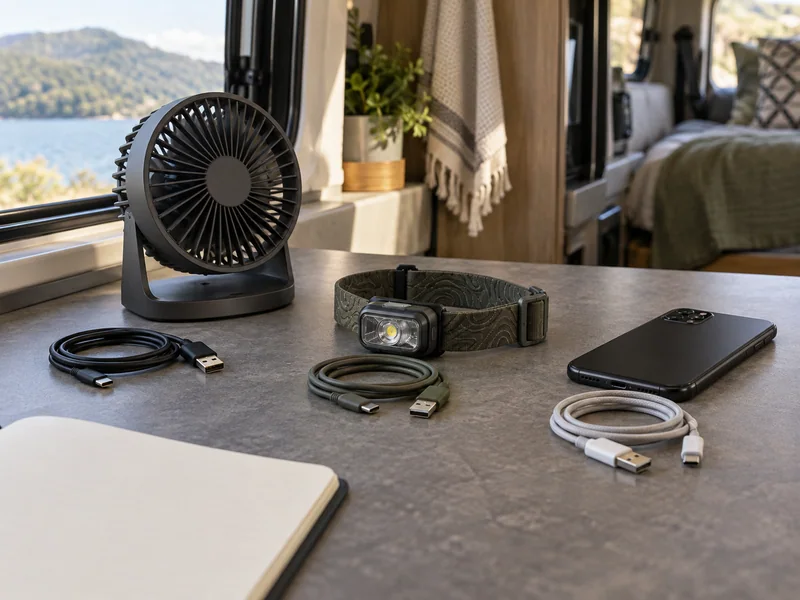
Your daily device worksheet
Copy this table into a spreadsheet or print it to fill in by hand. If you already know daily Wh from a representative measurement, enter that directly and note it in the evidence column. Do not multiply that energy figure by hours again.
| Device and whether essential | Average W, if known | Hours per day | Daily Wh | Evidence and conditions |
|---|---|---|---|---|
| Lights: ________ | ________ | ________ | ________ | ________ |
| Phone or camera charging: ________ | ________ | ________ | ________ | ________ |
| Laptop: ________ | ________ | ________ | ________ | ________ |
| Fan: ________ | ________ | ________ | ________ | ________ |
| Refrigerator, if used: ________ | ________ | ________ | ________ | ________ |
| Other: ________ | ________ | ________ | ________ | ________ |
| Total daily energy | ________ | Missing information: ________ |
For a steady or properly averaged load, daily Wh = average W × hours per day. Keep measurements at a consistent point in the system where possible. Energy measured at a device’s input and energy taken from the battery are not interchangeable when equipment between them consumes energy.
Add a clearly labeled sample day
Every number in this example is invented to demonstrate the arithmetic. It is not a typical-device claim, a measured campsite result, or a suggested list of equipment.
| Hypothetical load | Assumed use | Calculation | Daily energy |
|---|---|---|---|
| Light | Average 6 W for 4 hours | 6 × 4 | 24 Wh |
| Fan | Average 15 W for 6 hours | 15 × 6 | 90 Wh |
| Laptop | Average 45 W for 2 hours | 45 × 2 | 90 Wh |
| Phone charging | Assumed total for the day | Enter energy directly | 20 Wh |
| Total | 24 + 90 + 90 + 20 | 224 Wh |
Two days with this same use require 448 Wh delivered to the devices. This example contains no refrigerator or electric cooking load. Adding either requires another estimate; it cannot be covered by assuming the sample total is a complete camping budget.
Account for losses and name your reserve
Advertised capacity and energy delivered to devices can differ because of usable battery limits, conversion losses, equipment overhead, operating conditions, and the outputs used. Prefer the manufacturer’s relevant documentation and your own representative observations. Do not apply a generic efficiency figure as though it were a specification for every product.
Here is a second, explicitly hypothetical calculation:
- Device demand between charges: 448 Wh.
- Chosen planning reserve: 20% of that demand, or 89.6 Wh.
- Required energy delivered to the devices including reserve: 537.6 Wh.
- Assumed fraction of advertised capacity reaching those devices: 0.85.
- Illustrative advertised capacity calculation: 537.6 ÷ 0.85 = about 633 Wh, rounded up.
The 20% reserve and 85% delivered fraction are teaching assumptions, not recommended defaults or tested performance. Here, “reserve” means extra energy equal to 20% of estimated demand. It does not mean finishing with 20% displayed battery charge. The delivered fraction already represents the assumed total difference between advertised and delivered energy, so adding the same losses again would double-count them.
For your plan, write the basis for each allowance:
| Budget input | Your value | Evidence or reason |
|---|---|---|
| Daily device energy | ________ Wh | ________ |
| Days between dependable charging | ________ days | ________ |
| Device demand for that interval | ________ Wh | ________ |
| Reserve amount and how it is defined | ________ | ________ |
| Usable or delivered capacity information | ________ | ________ |
| Losses or overhead not already included | ________ | ________ |
Check output and replenishment separately
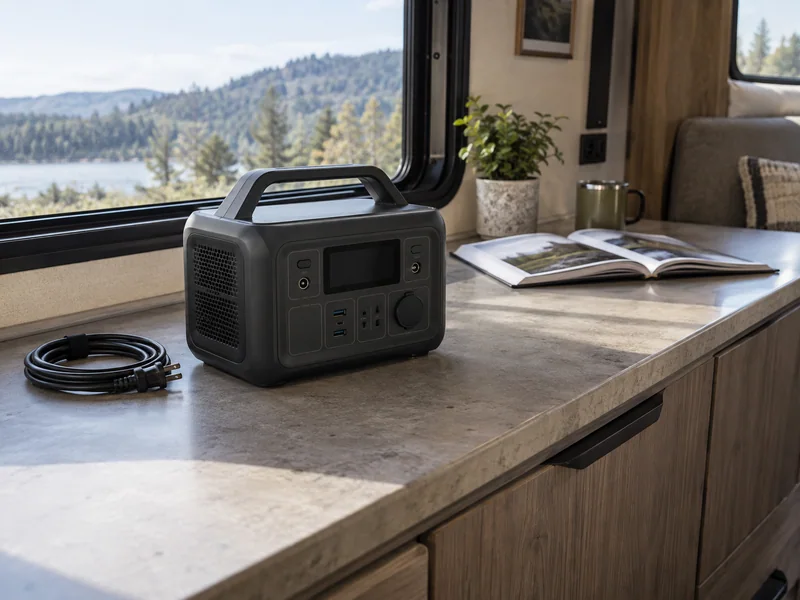
List the devices that may run together. Check the exact power station’s continuous output, individual port ratings, shared port limits, and supported charging standards against their requirements. Where an appliance has a startup demand, verify that separately in the relevant documentation. Sufficient Wh does not prove that the appliance is compatible.
Next, list actual charging opportunities: source, permitted connection, available time, and expected energy replenished under supported conditions. An unconfirmed campground outlet is not a dependable charging stop. Treat sunshine as uncertain unless you have a plan that still works when its contribution falls short.
For a route with changing overnight bases, put charging stops alongside travel and arrival times in the coastal road trip planning sheet. A battery that can recharge eventually may still not recharge during the time your itinerary allows.
Once the daily demand is recorded, use the RV solar planning calculator to compare explicit sun-hour, loss and reserve assumptions. It includes a separate period with no charging and a CSV of your scenario; it does not establish an electrical installation design.
Run a rehearsal and set priorities
Use the equipment as instructed for a representative day, then compare observed energy use with the worksheet. Note temperature, use duration, background loads, and whether measurements describe input or output energy. A displayed charge percentage can help you observe a trend, but is not by itself a precise measurement of delivered Wh.
- Every essential device has an energy estimate with a source.
- Cycling and standby loads are accounted for where relevant.
- The longest interval between dependable charges is covered.
- Reserve and losses are explicit and not counted twice.
- Simultaneous loads, startup requirements, and port compatibility have been checked.
- There is a plan for a missed or shorter charging stop.
- Optional loads are identified in the order you would reduce them.
Record the first optional use you would cut: ________. Record the condition that would make you change the trip plan: ________. Keep essential needs supported by an appropriate backup rather than relying on cutting discretionary use alone.
Finally, check where the equipment and charging cables will sit. The bed and storage access sheet can help keep them out of exits and accessible in both daytime and sleeping arrangements. Follow the equipment’s ventilation and placement instructions, and use a qualified installer for permanent vehicle electrical work.
Sources & further reading
Use these original sources for the full context and the latest guidance.
Prepared with AI assistance. Read our editorial approach.
This is a researched planning guide, not a report of a hands-on product test.
Last updated .