RV Solar Calculator: Estimate Energy, Panels, and Storage
Estimate an RV solar energy scenario with your own demand, sun hours, losses, and reserve. Compare panel output and no-charge storage, then download the calculation.
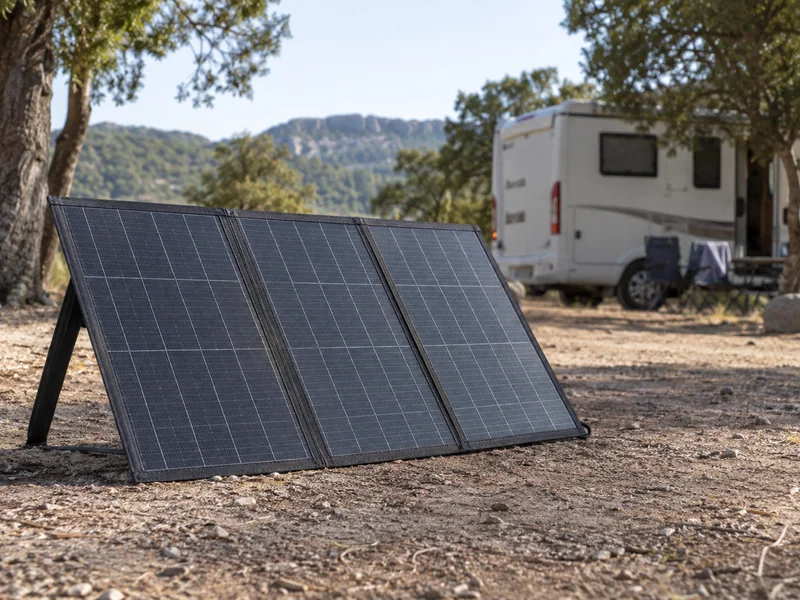
AI-generated illustration: solar planning depends on demand, available sunlight and the assumptions entered in the calculator.
Start with daily device energy in watt-hours, account for battery-to-device losses and separate overhead, then subtract dependable non-solar charging. Divide the remaining energy target by equivalent sun hours and your solar-side yield assumption to explore panel ratings. Check no-replenishment storage separately, and take the assumptions and results to a qualified RV electrical designer before choosing an installation.
Try your solar planning scenario
Enter your own estimates, or load the worked example to see the arithmetic. All values are required, including explicit zeros. The example is hypothetical.
Calculations run in this page. Your entries are not sent to a server or saved after you leave. Download a scenario before closing if you want to keep it.
An RV solar calculator is most useful when it makes the assumptions visible. “How many watts do I need?” depends on the energy you use, when you use it, the place and season, available charging, and what happens when the expected sunlight does not arrive.
Use the calculator above to compare energy scenarios. It estimates a daily panel-energy balance and a separate storage requirement for a period with no replenishment. It does not choose panels, a battery chemistry, wiring, fuses, controllers or an inverter. Those require equipment documentation and a qualified design for the actual vehicle.
The worked example is deliberately hypothetical. Loading it makes the form easier to understand; it does not establish recommended efficiency, reserve or sunshine settings for your trip. Your values stay in the page, and you can download a CSV of a completed scenario.
Begin with a daily energy budget
Enter the energy delivered to your devices during one representative day, in watt-hours. The camping power budget worksheet helps build that number from individual loads. Include refrigeration, heating controls, fans and background use when they apply, rather than treating a list of phone chargers as the whole vehicle demand.
Watts and watt-hours answer different questions. As the EIA explains, watts express power and watt-hours express energy over time. A hypothetical steady 20 W load running for three hours uses 60 Wh. A 1 kWh energy reading is 1,000 Wh; it is not 1 W or 1,000 hours.
For cycling loads, use a representative energy measurement or a documented estimate appropriate to the conditions. A refrigerator’s running wattage multiplied by 24 can misrepresent a day if it cycles. A charger rating is not automatically average device consumption.
Keep the measurement point consistent. If you have already measured the whole day’s energy at the battery, enter that battery-side demand with a 100% delivered fraction and zero additional overhead when everything is included. Do not reduce it for the same conversion losses a second time.
Understand the three different fractions
The calculator separates three percentages because they describe different parts of the energy path. They are not interchangeable product ratings.
| Input | Meaning here | Common mistake |
|---|---|---|
| Battery-to-device delivered fraction | Share of energy removed from storage that reaches the counted devices | Treating inverter conversion efficiency as the whole system’s delivered fraction |
| Panel-to-stored-energy yield | Share of nameplate watts times equivalent sun hours that becomes stored energy under the assumed conditions | Applying shade or charging loss once in the yield and again elsewhere |
| Usable fraction of rated battery energy | Share of advertised battery Wh available within the chosen operating limits, before device-side conversion | Confusing it with the delivered fraction or the percentage shown on a display |
Additional battery-side overhead is for consumption that the other inputs have not already covered. For example, you might have a separately documented background demand that sits outside device measurements. Do not add an arbitrary overhead allowance after choosing a fraction that already includes the same overhead.
Use a common basis for all charging figures too. The “other dependable energy stored” input is energy reaching storage after that source’s charging losses. A charger’s rated watts multiplied by the hours it is connected is not necessarily that stored energy.
Use equivalent sun hours, not daylight hours
Equivalent peak sun hours express a solar-resource amount as hours at a reference irradiance of 1 kW per square meter. They are not a count of daylight hours or hours during which the panel shows any output. The relevant resource also depends on the surface orientation being modeled.
The Department of Energy’s solar-radiation overview describes variation with location, season, landscape and weather, and distinguishes energy-per-area measurements from instantaneous power. A long summer day and an unobstructed panel are different inputs from a shaded parking spot or a winter stay.
Record where a sun-hour estimate came from, the month, panel orientation and whether losses have already been applied. A monthly resource estimate cannot promise the weather for one camping weekend. Run another scenario with lower sun hours and a scenario with zero solar input.
PVWatts provides a more detailed resource and production model and explains its assumptions and uncertainty. Its documented scope is grid-connected photovoltaic generation. Its output should not be copied into this RV tool as though it were battery-stored energy without accounting for the different model and measurement point. This page does not fetch weather data or run PVWatts in the background.
Read the panel result as an energy scenario
Let D be daily energy delivered to devices, e be the battery-to-device fraction, O be separate overhead, C be other daily energy stored, and r be the extra planning allowance as a fraction.
The first calculation is:
Battery demand B = D ÷ e + O.
The part assigned to solar is G = the greater of zero or B minus C. The solar replacement target, including the chosen allowance, is T = G × (1 + r).
If H is equivalent sun hours and y is the panel-to-stored-energy yield fraction, the estimated panel nameplate rating is P = T ÷ (H × y). Fractions are decimals in these equations: 80% becomes 0.80. The form converts the entered percentages for you.
| Quantity | Unit | What the result establishes |
|---|---|---|
| B, daily battery demand | Wh/day | The modeled energy removed from storage each day |
| T, solar replacement target | Wh/day stored | The energy assigned to solar, with the chosen extra allowance |
| P, calculated panel rating | W | A nameplate-power estimate under the entered H and y assumptions |
| Compared panel harvest | Wh/day stored | Candidate watts × H × y |
| Daily balance before allowance | Wh/day | Compared harvest plus other charging minus B |
If sun hours are zero and the solar target is positive, no finite panel rating can satisfy the model. The calculator says so instead of displaying infinity or silently replacing zero with a sunny-day assumption.
If other charging covers the whole daily demand, the modeled solar requirement is zero. That result depends on the charging opportunity actually existing. Record its permitted use and expected availability in your RV arrival and departure plan.
Follow the worked example
Every value here is invented for arithmetic. It does not represent a tested vehicle, product or typical campsite.
| Example input or step | Hypothetical value | Calculation |
|---|---|---|
| Daily device energy | 800 Wh | Entered total |
| Delivered fraction; separate overhead | 80%; 0 Wh/day | 800 ÷ 0.80 = 1,000 Wh/day from storage |
| Other energy stored each day | 200 Wh | 1,000 minus 200 = 800 Wh/day assigned to solar |
| Extra planning allowance | 25% of the solar gap | 800 × 1.25 = 1,000 Wh/day solar target |
| Sun hours and solar yield | 4 h/day; 75% | Each rated watt corresponds to 4 × 0.75 = 3 Wh/day stored |
| Calculated panel rating | About 333.3 W | 1,000 ÷ 3; displayed rounded up as 334 W |
| Compared panel rating | 400 W | 400 × 4 × 0.75 = 1,200 Wh/day stored |
| Daily balance before allowance | +400 Wh/day | 1,200 + 200 minus 1,000 |
Now change only the sun hours from four to two. The estimated panel rating doubles to about 666.7 W, while the compared 400 W array’s estimated harvest falls to 600 Wh/day. With the same other charging, the daily balance becomes negative 200 Wh. The point is how sensitive the plan is to that one assumption, not that either panel size is the right product.
A positive daily total also does not describe timing. The battery must supply overnight loads before the next day’s solar input. Starting nearly empty, missing a charging stop or reaching an equipment input limit can change the practical outcome even if a daily sum looks positive.
Check a separate period with no charging
The storage calculation uses the entered daily battery demand, the number of days without replenishment and the same extra planning percentage. It assumes both solar and other charging are absent for that period.
Usable stored energy = B × no-charge days × (1 + r).
Divide that usable energy by the entered usable fraction to get an illustrative rated-battery Wh figure. Battery-to-device losses were already accounted for in B. They are not added again here.
In the worked example, two no-charge days require 1,000 × 2 × 1.25 = 2,500 usable stored Wh. With an assumed 80% usable fraction, the calculated rated energy is 2,500 ÷ 0.80 = 3,125 Wh. The daily 200 Wh from other charging is intentionally absent from this separate fallback scenario.
The 25% allowance is extra modeled energy. It does not mean the battery should finish at 25% displayed charge. This tool also does not calculate recovery time after the no-charge period, battery aging, temperature-dependent capacity or detailed charge acceptance. Check those with the exact equipment and a qualified designer.
Take the right questions to the equipment review
A panel nameplate number is not a compatibility check. The SAM system-design documentation identifies nameplate capacity at standard test conditions and treats other system characteristics separately. The watts calculated here do not specify array voltage, controller current limits, cable sizes or rooftop attachments.
Before purchasing or changing an installation, bring the following information to someone qualified to design it:
- Your measured or estimated daily energy use and the conditions behind it.
- Essential loads, simultaneous demand and any startup requirements.
- The actual vehicle, battery and charging-equipment documentation.
- Available space, shading, operating temperatures and charging windows.
- The period with no dependable charging and a plan if that period grows.
- Questions about product compatibility, protection, mounting and permitted installation.
For a longer transition, add the cost and availability of alternative charging to your full-time RV planning questions. A weekend example should not quietly become a year-round off-grid promise.
Keep an input record you can improve
Print this worksheet or save the scenario CSV. The CSV records the entered values and unrounded calculated results; it does not preserve a source for a number unless you keep that separately. The browser does not retain your entries after you leave.
| Input record | Your value or source | What needs checking |
|---|---|---|
| Daily device energy and measurement point | ________ | Representative use and cycling loads |
| Delivered fraction and separate overhead | ________ | No missing or double-counted losses |
| Other dependable charging | ________ | Stored energy and actual availability |
| Sun hours, place, season and panel plane | ________ | Lower-sun scenario and shading |
| Solar yield assumption | ________ | Which losses are already included |
| Extra planning allowance | ________ | Meaning and reason for the chosen amount |
| No-charge days and usable battery fraction | ________ | Operating limits and fallback duration |
After representative use, compare observed energy with the assumptions at the same measurement point. Revise the inputs that were wrong instead of adding an unexplained margin to every figure. The best outcome from this calculator is a clearer energy plan and a useful set of questions for the actual system review.

Sources & further reading
Use these original sources for the full context and the latest guidance.
- EIA: Measuring electricity (opens in a new tab)
- Department of Energy: Solar Radiation Basics (opens in a new tab)
- PVWatts: Calculator assumptions and system losses (opens in a new tab)
- System Advisor Model: PVWatts system design (opens in a new tab)
- National Laboratory of the Rockies: PVWatts model and API scope (opens in a new tab)
Prepared with AI assistance. Read our editorial approach.
This is a researched planning guide, not a report of a hands-on product test.
Last updated .