Full-Time RV Living: Questions to Resolve Before You Start
Map the practical questions behind full-time RV living, from space and routines to location-specific requirements. Build a research plan before committing.
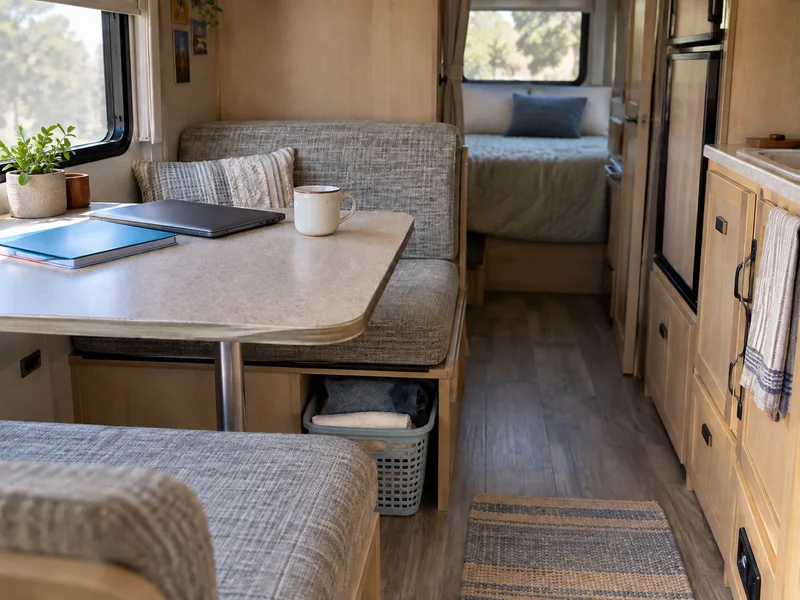
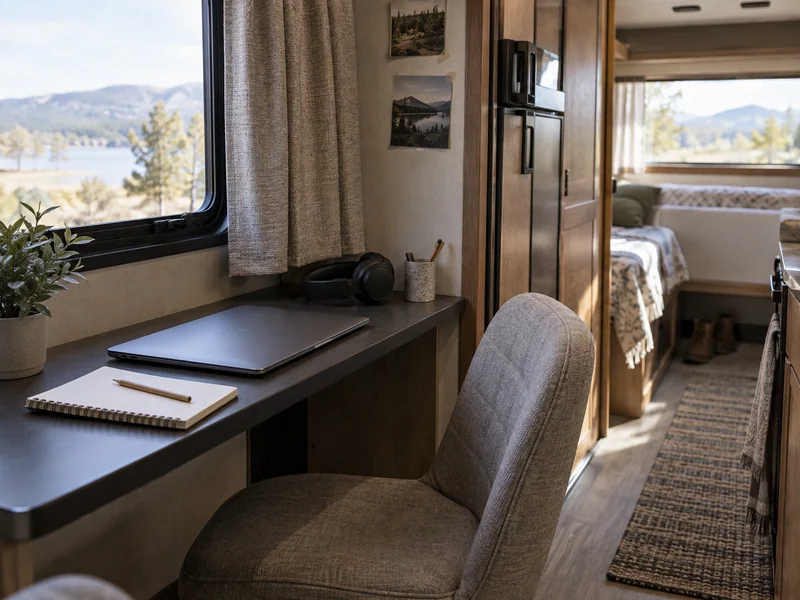
AI-generated illustration: full-time RV planning includes ordinary work, laundry and household routines.
Prepare for full-time RV living by planning an ordinary week, a lawful place to stay, service access, work requirements and a way to pause or return. Separate mail delivery from residence and other legal questions, and confirm location-specific requirements with the responsible agencies and professionals. Use actual quotes and your own observations to build the plan. This guide provides research questions rather than personal full-time experience or a universal cost estimate.
Full-time RV living includes the day after a pleasant campsite evening: work, laundry, appointments, maintenance and the question of where you are allowed to stay next. Planning those ordinary days is more useful than copying someone else’s highlight reel or monthly spending total.
This guide is a researched transition plan. It does not describe a full-time life we have lived, recommend a state for domicile or predict what your household will spend. The worksheets help turn a broad idea into questions you can answer with current official information, actual quotes and observations from your own trial trips.
Describe the life you need the RV to support
Write an ordinary weekday from waking to bedtime. Include paid work, caregiving, study, meals, exercise, rest and personal time. Add tasks that currently happen almost invisibly at home, such as receiving a replacement card or waiting for a repair appointment.
If more than one person is involved, write the schedules separately before combining them. Two people can both need a quiet call at the same time. A bed that converts into a desk may fit one schedule but interrupt another person’s rest. Identify the actual conflict instead of assuming everyone will adapt once traveling begins.
Make a short list of requirements you will not trade away. Examples might include access to a particular medical service, a permitted work location, a suitable sleeping arrangement or a private place for each person to decompress. Use those requirements to assess vehicles and travel patterns, rather than purchasing a layout first and trying to make the household fit it.
Try ordinary routines before making irreversible changes
When practical, use a suitable rental or existing RV for a trial that includes normal responsibilities. A vacation where nobody works and every meal is special answers different questions from a week with deadlines, laundry and a rainy afternoon indoors.
Record what actually happens. How often does the sleeping area have to be cleared? Which task occupies the only table? Can everyone reach clothing without moving another person’s belongings? Our RV storage guide helps map those access problems by zone.
Do not turn a short trial into proof that every season or location will work. Keep weather, location, services, occupancy and equipment in the notes. A comfortable stay with full services leaves different questions open from a stay with limited water or power.
| Ordinary-day task | What to observe during your own trial | Question left for the longer plan |
|---|---|---|
| Work or study | Space, noise, connection and equipment actually used | Can this be repeated at the intended locations? |
| Meals and cleanup | Storage access, preparation space and washing routine | Where will replenishment and disposal happen? |
| Sleep and privacy | Interruptions, personal space and conversion work | What changes when schedules differ? |
| Laundry and clothing | Amount used and time spent finding a permitted service | Does the route support a repeatable routine? |
| Appointments and deliveries | Travel or waiting required | Which obligations need a planned return location? |
| A day indoors | Space for separate activities and rest | Can the household tolerate longer poor-weather periods? |
| Departure | Work needed to restore the travel configuration | Is the planned moving frequency realistic? |
Leave the observation column blank until you have something real to record. These are original prompts, not findings from a completed trial.
Build a route around permitted stays and necessary services
Choose a few candidate locations and verify the current rules for each. Record the permitted stay, reservation terms, season, vehicle restrictions and services that are actually available. Ask the operator about longer stays when relevant, and keep the answer with the booking information.
Do not treat public land as an unlimited housing plan. The Bureau of Land Management’s camping guidance says dispersed camping is for short-term recreation, with designated Long-Term Visitor Areas as a distinct exception. It also states that stay limits and local rules vary. Confirm the specific land unit, dates and conditions with the responsible office instead of assuming a general number applies everywhere.
Add the places required to support the stay: groceries, suitable water access, permitted waste disposal, laundry, maintenance and any appointments. A scenic location with no workable service plan may create more driving than a less dramatic base.
The slow road-trip planning guide helps reduce an itinerary to manageable stops. For full-time planning, add recurring obligations and dates when you must be somewhere. Keep an alternative location for a closure, unsuitable site or unexpected service interruption.
Separate mail, residence and administrative requirements
Make a list of organizations that need an address, then ask each what type of address and documentation it requires. Mail delivery, vehicle registration, licensing, insurance, voting and tax questions are not interchangeable. The answer for one form should not be copied into every other record without checking.
The USAGov state-government directory is a starting point for locating official state agencies. Use the responsible motor vehicle, tax, election or other agency for the question involved. Discuss your actual circumstances with an appropriately qualified professional when a legal, tax or insurance decision is needed. This guide cannot determine which jurisdiction applies to your household.
One concrete example shows why the distinction matters: the USPS agreement for its PO Box Street Addressing Service does not allow that address to be used as a physical residence or place of business in legal documents. That is a condition of this particular service, not a conclusion about every mail provider or every residency question.
Ask a mail service how forwarding, package collection, time-sensitive documents and account changes work. Record fees and practical collection arrangements. Keep sensitive identity documents in an appropriate secure system; there is no need to place account numbers or personal records on a shared travel checklist.
| Question to resolve | Who can provide the applicable answer | Record to retain |
|---|---|---|
| Which address and documents does a government process require? | The agency responsible for that process; qualified adviser when needed | Current official instructions and your applicable decision |
| Does the insurance cover the intended vehicle use and travel pattern? | The insurer or licensed representative | Written policy terms, declarations and clarification |
| What happens to health coverage or care access? | Plan administrator, insurer and relevant care providers | Coverage details and a practical continuity plan |
| Can a location be used for the intended length and purpose? | Land manager, campground operator or responsible local authority | Current permission, rules and booking terms |
| How will important mail reach you? | The selected mail provider and each organization sending documents | Service agreement and collection or forwarding process |
| Can paid work be carried out from the intended locations? | Employer or client and qualified advisers for applicable obligations | Permission and the requirements that affect the route |
Plan healthcare continuity separately from travel convenience
List regular care, prescriptions, equipment and appointments that need continuity. Ask the relevant providers and plan administrator how the actual travel pattern affects access, refills, networks and costs. A general promise of nationwide service does not answer every question about a particular appointment or prescription.
If your circumstances involve a move, check the process for your coverage. For example, HealthCare.gov’s Marketplace guidance explains that moving to another state requires a new Marketplace application and plan enrollment. That specific rule should not be generalized to every insurance arrangement or used to decide whether a travel pattern legally constitutes a move.
Keep an accessible list of essential contacts and decide how records will be available when needed. Make a separate plan for anyone whose equipment depends on reliable power or particular environmental conditions. Obtain the relevant professional guidance before relying on an RV system for that need.
Check whether the workday can function
Start with the employer’s or client’s requirements: permitted locations, security, working hours and the applications that must function. Then check the physical workspace and connection options. A dining table and a coverage-map color do not establish a dependable working day.
The FCC’s explanation of its National Broadband Map says mobile coverage is provider-reported and represents outdoor or in-vehicle coverage, not indoor coverage. Use the map to identify questions and candidate providers. It is not a test of a video call from your chosen desk.
Where practical, check the actual applications at the intended location and working times before depending on them. Record the device, service and location with your observations. Identify a permitted alternative workspace or other backup that meets your work requirements. Do not assume a neighboring business’s connection is available for an entire workday.
Use the camping power budget to include the equipment and charging needs. Keep that estimate separate from checking electrical compatibility and reliable supply. Consider what happens to work if the RV is in a repair facility and cannot serve as an office.
Build the budget from your own quotes
Create two records: transition costs and recurring costs. Buying or preparing the RV, disposing of household belongings and establishing services belong in the transition record. Campsites, travel, food and recurring obligations belong in the ongoing record. Keep a separate allowance for irregular costs that will not appear neatly every month.
Use current quotes and actual trial spending where available. Note what each quote includes, the date and the conditions. Do not assume a monthly campsite rate includes every utility or that a vehicle warranty pays for alternative accommodation. Read the applicable terms.
| Cost area | Input to gather | How to make the uncertainty visible |
|---|---|---|
| Vehicle acquisition and preparation | Actual purchase, rental, inspection or preparation quotes | Keep one-time costs separate from ongoing use |
| Places to stay | Written rates and included services for candidate locations | Record seasonal differences and cancellation terms |
| Travel | Intended route and your own vehicle information | Compare a slower route with more frequent moves |
| Household services | Food, laundry, mail and connectivity costs | Note which expenses change with location |
| Insurance, healthcare and obligations | Applicable policy costs and existing commitments | Retain the assumptions behind each figure |
| Maintenance and interruption | Service information and realistic backup arrangements | Keep funds for costs not covered by routine spending |
| Returning or pausing | A practical accommodation and transport plan | Record what remains available if travel stops |
Avoid turning another household’s total into your target. Different vehicles, obligations, travel speeds and service needs produce different plans. Revisit the figures after you have relevant observations rather than treating the first spreadsheet as a forecast.
Decide what happens when the RV cannot be home
Identify where people, pets, work equipment and essential belongings can go during repairs or an unsuitable-weather period. Check the practical terms of any accommodation option, including transport and pet arrangements where relevant. Keep the plan reachable without needing to unpack the RV.
Follow the vehicle and component maintenance requirements, and ask the manufacturer or qualified service provider about the intended use. The RV camping checklist provides a structure for vehicle readiness and each arrival or departure. Full-time planning adds the longer calendar of servicing and the consequences of losing access to the vehicle.
Agree on reasons to pause or change the plan. They might include a work arrangement that no longer functions, health needs, repeated budget pressure or a household member wanting a different living situation. Giving those decisions a place in the plan makes them easier to discuss before a stressful day.
Keep the initial commitment reversible where possible. Resolve the major unanswered questions, arrange a realistic first route and set a date to review what you have learned. Full-time RV living is a household decision with changing conditions, so the research plan should remain something you can update.
Sources & further reading
Use these original sources for the full context and the latest guidance.
- Bureau of Land Management: Camping on public lands (opens in a new tab)
- USAGov: State governments and official agencies (opens in a new tab)
- USPS: Customer agreement for premium PO Box service enhancements (opens in a new tab)
- HealthCare.gov: Reporting a move to the Marketplace (opens in a new tab)
- FCC: How to use the National Broadband Map (opens in a new tab)
Prepared with AI assistance. Read our editorial approach.
This is a researched planning guide, not a report of a hands-on product test.
Last updated .