RV Bathroom Storage Ideas for Small, Damp Spaces
Plan RV bathroom storage around moisture, access, and travel movement. Use your own measurements to compare options for toiletries, towels, and cleaning supplies.
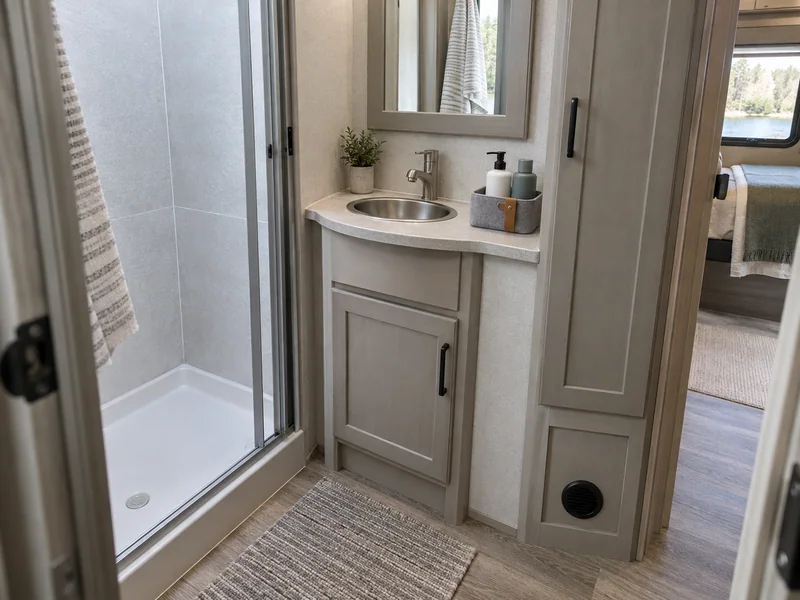
AI-generated illustration: A compact bathroom concept separates the dry cupboard from the temporary place used for a daily toiletry caddy.
Give bathroom items a dry storage home, a practical place during use, and a secured travel position. Measure door and fixture movement with your own supplies before choosing a caddy, shelf, or hook.
Give each item a home before and after the shower
RV bathroom storage needs to handle more than the clean, dry items in a cabinet. It also needs to handle the towel after use, the wet soap container, and the toiletries that have to move before driving.
Start with three questions for each item: Where does it stay dry? Where does it sit while I use it? Where does it travel? Sometimes one place can serve all three purposes. Sometimes a removable caddy or a separate dry cabinet makes the routine simpler.
Use your own bathroom measurements throughout this guide. The worksheets are not measured plans, a before-and-after makeover, or a test of mounting strength. They help you evaluate storage in an existing bathroom without changing plumbing, fixtures, or ventilation.
If the bathroom is competing with other areas for supplies, consult the whole-RV storage map. The bathroom may need the toiletries used today while unopened replacements remain in another suitable location. Moving a backup supply can be more useful than adding a rack beside a fixture.
Separate splash exposure from dry storage
In a wet bath, where the shower shares space with the toilet and other fixtures, expect the shower-use area to need a different storage plan from a separate dry cabinet. In a bathroom with a separate shower, nearby shelves may still receive splashes or damp items. Look at your actual arrangement instead of relying on the bathroom’s label.
Begin with the supplies you use in one normal day. Keep the inventory short enough to lay out and inspect. Give every wet return an intermediate destination before it goes back into dry storage.
| Item group | While stored | During use | Before returning to storage |
|---|---|---|---|
| Clean towels | Suitable dry location | Within reach without obstructing movement | Separate used towels from the clean supply |
| Shower toiletries | Containers closed and arranged as their labels require | Reachable without blocking controls or the drain | Check closures and deal with water on the container |
| Toothbrush and daily wash items | Appropriate clean storage for the item | On a usable surface or suitable holder | Follow product care and drying instructions |
| Toilet paper and other dry supplies | Protected from splash and wet returns | Accessible in the intended fixture position | Replace damp storage arrangements, not just wet contents |
| Cleaning products | Label-compliant, secure location separate from personal items | Brought out for the cleaning task | Close and return the original containers |
This is a movement plan, not a claim that a particular basket keeps supplies dry. If you cannot identify a suitable dry place, reduce what stays in the bathroom or use another approved storage zone.
The Winnebago Towables 2025 owner’s manual recommends using bath ventilation while showering to carry out water vapor. Keep storage from interfering with the ventilation your model requires. A new caddy does not resolve a leak or establish a humidity-control result.
Measure with doors and fixtures in their working positions
Measure the usable opening, then record everything that moves into the proposed storage space. Include a bathroom door, cabinet door, shower enclosure, toilet lid, pedal, and controls where applicable. Check the requirements for the actual fixture; this guide does not prescribe a universal clearance around it.
Try the intended daily motions while parked: enter, close the door, reach the towel, use the sink, and leave. Leave out mounted products that have not been approved and installed according to their instructions. You can compare positions on paper before buying anything.
| Clearance check | Your measurement or observation | Decision |
|---|---|---|
| Bathroom door at its required open and closed positions | ___ | ___ |
| Cabinet opening with proposed container in place | ___ | ___ |
| Toilet lid, pedal, and user access as applicable | ___ | ___ |
| Shower door or curtain movement | ___ | ___ |
| Faucet and shower controls reachable | ___ | ___ |
| Ventilation opening and controls available | ___ | ___ |
| Service panel and its removal path available | ___ | ___ |
| Drain area free of stored items | ___ | ___ |
| Path needed to carry out the filled caddy | ___ | ___ |
Use the cabinet fit and removal checks if an enclosed bathroom cupboard has a narrow opening or projecting hinge. Then return to the bathroom-specific questions: splash exposure, fixture movement, cleaning access, and the destination of wet items.
A door-mounted pocket needs checking while filled. Empty fabric lies flatter than shampoo bottles and folded towels. Include the fullest condition you actually intend to carry, and do not assume the door or its attachment can support it. Door clearance and mounting suitability are separate decisions.
Choose a daily toiletry arrangement you can put away
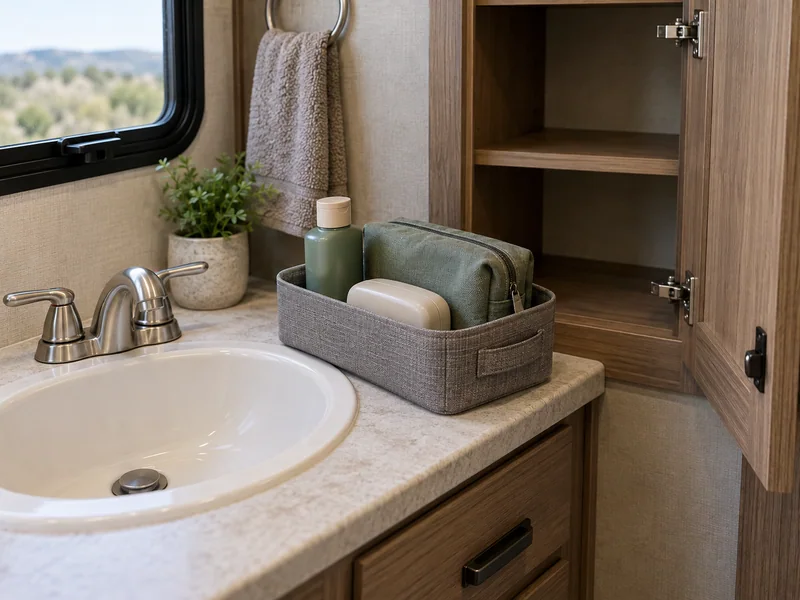
Compare storage methods by the routine they support. A removable container may suit a shared campground bathroom as well as the RV, but it still needs an appropriate travel location. A fixed holder may keep one item reachable while leaving more pieces attached to check and clean.
| Option | Useful task | Main question before choosing |
|---|---|---|
| Small removable caddy | Carry daily toiletries together | Can you lift it out, set it down, and return it without blocking access? |
| Personal toiletry bag | Keep each traveler’s items identifiable | Can the bag and its contents be cared for and dried as instructed? |
| Cabinet tray | Remove one group from a narrow cupboard | Does the loaded tray pass through the opening and leave the latch working? |
| Product-specific shower holder | Hold a needed item during washing | Is it intended for that exposure, surface, load, and installation? |
| Existing shelf with fewer items | Keep frequently used supplies visible | Do contents remain suitable for the location and secured for travel? |
Start with the smallest inventory that covers your real routine. Store backup bottles only where their labels and the vehicle’s storage limits allow. Do not move medicines into a generic bathroom organizer for convenience; follow their storage directions and retain appropriate secure packaging.
Keep the person who uses the item in the decision. A container on a high shelf may fit but be awkward to retrieve. A low open basket may be accessible to a child who should not have access to the contents. “Easy to reach” needs to mean the right person can reach it.
Plan the towel’s return route
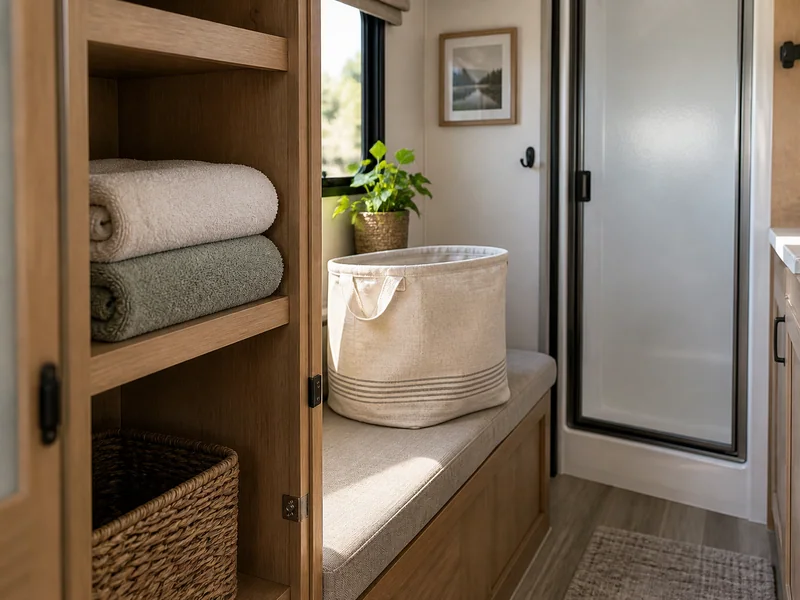
Count clean towels separately from used ones. The dry supply does not need to occupy the same space as the towel currently in use. If you keep backups in a sleeping area, use the bed and storage access worksheet to check whether they remain reachable with the bed made.
Decide what happens after bathing before choosing a hook. Where will the used towel go? Can that place accommodate its full shape without covering controls, ventilation, or a doorway? What happens if you need to leave before it is dry?
Follow your RV and textile care guidance for drying. Do not treat an enclosed cabinet as a drying solution, and do not assume that hanging a towel in a particular spot produces a predictable drying time. Weather, ventilation, materials, and the actual space vary.
Copy this return routine and fill in the locations:
| Stage | Your plan |
|---|---|
| Clean towel before use | ___ |
| Place reached from the shower without blocking access | ___ |
| Suitable location for the used towel, following care guidance | ___ |
| Action if packing begins while it is still damp | ___ |
| Destination for used laundry after the trip | ___ |
Hypothetical example: two travelers decide to keep only the towels currently in use in the bathroom, with clean replacements in another permitted dry cabinet. The question to check is whether either traveler can retrieve a replacement without moving the used towels or blocking the door. This example gives no capacity or drying-performance result.
Check the exact mounting product and the RV finish
Bathroom exposure matters when selecting an adhesive product. Command’s official FAQ distinguishes its bath products with water-resistant strips from regular products for humid areas. Its package-specific surface and load limits still apply. That distinction does not establish suitability for every RV wall or for retaining items during travel.
Before installation, identify the actual surface, not simply its appearance. A finish that looks like wood or tile may be another material. Check the RV finish guidance alongside the organizer instructions, including preparation, waiting time, removal, and any restrictions. If those requirements conflict or the material is unknown, do not improvise the installation.
Removal can be the deciding constraint in a small bathroom. Command’s hook instructions require a particular removal movement. A shelf, countertop, or fixture below the adhesive tab may leave insufficient access. Confirm the exact product’s method before positioning it.
Record the product and its documented conditions, rather than writing “strong hooks” on the shopping list. A stated product rating is not a test of the vehicle surface, and a parked installation check does not establish performance during sudden vehicle movement. Use an appropriate secured travel arrangement for loose items.
| Item and wet or dry location | Your measured clearance | Exact surface and proposed container or mounting product | Product conditions and limit checked | Access result or open question |
|---|---|---|---|---|
| ___ | ___ | ___ | ___ | ___ |
| ___ | ___ | ___ | ___ | ___ |
Keep cleaning supplies identifiable and service areas open
Store cleaning products as their labels direct. The CPSC’s poison-prevention guidance recommends keeping household chemicals in their original child-resistant containers, locked away and out of children’s reach. A decorative open basket or unlabeled refill bottle does not provide that protection.
Give cleaning tools a separate place from personal toiletries. Choose an arrangement you can remove to clean the storage area without transferring a wet tool through the clean towel supply. Check that any containing tray is compatible with the products; a tray does not replace label-directed storage.
Leave service access available. In the Winnebago manual, plumbing equipment locations depend on the floor plan. Locate your own access points before placing anything against them. Do not fasten an organizer to a removable service panel or drill into a wall without the appropriate manufacturer-approved installation information.
Use one last check before packing the bathroom
- The filled arrangement leaves door and fixture movement available.
- Vents, controls, drains, and service access remain clear.
- Clean supplies are separated from wet returns and cleaning tools.
- Each item follows its own storage and care instructions.
- Mounting surfaces and product requirements are identified and compatible.
- Hazardous products remain in suitable original, secured packaging.
- Camp-use containers and loose items have an appropriate travel home.
- Doors and latches work in the loaded travel configuration.
When a routine remains awkward, name the exact movement causing it: reaching a towel, closing the door, or putting the caddy away. Fix that movement before adding another container to the room.
Sources & further reading
Use these original sources for the full context and the latest guidance.
Prepared with AI assistance. Read our editorial approach.
This is a researched planning guide, not a report of a hands-on product test.
Last updated .