Rainy-Day Camping Activities for a Small Covered Space
Plan quiet and active rainy-day camping activities around shelter, space, and age. Use printable prompts and a backup plan when conditions require leaving camp.
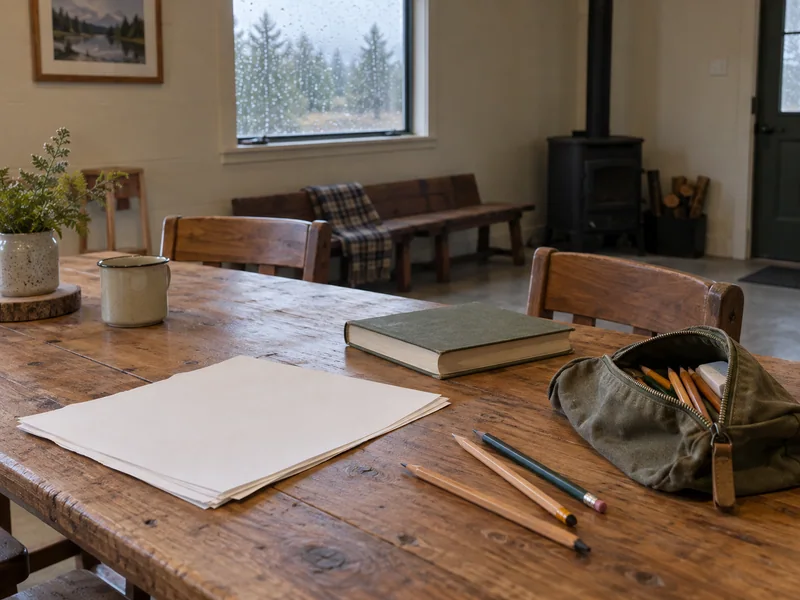
AI-generated illustration: choose a suitable place first, then bring out a compact activity set.
Choose rainy-day camping activities only after deciding whether the weather and shelter allow you to stay. For ordinary rain, a small set of paper games, drawing prompts and shared stories can fit a table or a seated space. Match the activity to each person's ability, leave exits clear and keep a separate option for resting. Thunder requires appropriate shelter, not another game inside a tent.
Rain changes a campsite’s usable space. The picnic table may be wet, the sleeping area may be crowded and someone may be ready for a quiet hour while everyone else wants to do something. A useful activity plan starts with those limits rather than a long shopping list.
The eight activities here use paper, pencils, conversation and optional familiar books or cards. The prompts were created for this guide and can be printed with the page. They have not been tested with a group, and no completion times or age-development benefits are claimed. Adapt them to the people present and stop when interest runs out.
Decide whether staying is appropriate
Check current conditions, campground instructions and your escape plan before putting out activities. A space that keeps paper dry is not necessarily a safe place during severe weather. Choose the substantial shelter and route before a storm makes movement difficult.
The National Weather Service’s camping example specifically identifies tents and open picnic shelters as unsuitable protection from lightning. When thunder is heard, move to appropriate shelter immediately. Its lightning guidance identifies a substantial building with electricity or plumbing, or an enclosed metal-topped vehicle with windows up, and says to remain sheltered for at least 30 minutes after the last thunder.
Do not delay moving to finish a round, collect scattered pieces or cook a snack. Avoid treating every RV, fabric shelter or covered structure as equivalent to the shelter described by the weather authority. Confirm the actual options at your destination. Activities in this guide apply only after that decision has been made.
For ordinary rain without a weather threat, keep the available area dry enough for the chosen activity, preserve ventilation and leave doors and walkways clear. If the space no longer works for the group, a suitable indoor destination or ending the outing may be the better plan. The family camping checklist provides a place to record that backup.
Match the game to the available space
Choose by what participants can comfortably do, not by an age label alone. Someone may enjoy listening but dislike reading aloud. Someone else may need larger writing space or a break from group noise. Offer a way to join without making the difficult part compulsory.
| Available space or preference | Start with | Adaptation | Avoid adding |
|---|---|---|---|
| Everyone can sit, but there is no clear table | Shared story or category conversation | An adult records ideas for people who prefer speaking | Loose pieces that disappear into bedding |
| A small clear table is available | Draw-and-pass map or memory sketch | Larger sheets and fewer details | More players than can reach comfortably |
| Reading and puzzles sound appealing | A simple message code or invented visitor guide | Read the clue aloud or work in pairs | A timed competition that excludes slower readers |
| Some movement is wanted | Seated mirror movements | Use hands, facial expressions or another comfortable movement | Running, jumping or games across exits and cooking areas |
| One person wants quiet | A private drawing, book or listening option | Allow watching without participating | Pressure to entertain the rest of the group |
Keep materials suitable for the participants. An adult should choose and supervise tools where needed, including pencils and any small pieces in a familiar game. None of the activities requires collecting plants, handling wildlife or going outside to fetch natural objects.
1. Build a campsite that could never exist
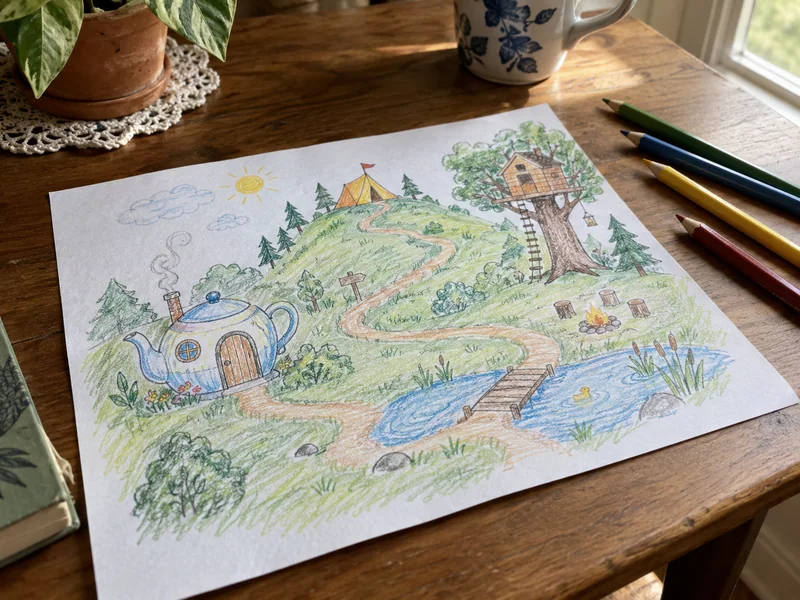
One player draws the entrance to an imaginary campsite in a corner of a page. The next adds a place to sleep, another adds something surprising and another adds a way to get around. Pass the sheet until everyone has added something they want to explain.
Give the drawing one useful constraint: every place needs a route to the entrance. That encourages players to connect their ideas without needing realistic engineering. A tent in the clouds might need a staircase drawn as a ribbon; a library in a teapot needs a door.
Finish by giving a short tour. Ask what visitors should bring, where they would eat and which part should be quiet. Younger participants can describe a feature while someone else draws it. This is imaginative mapmaking, not a real campsite plan or a reason to change the layout of your current site.
2. Tell a story through three objects
Choose three ordinary items already visible in the activity space, such as a sock, a pencil and a mug. Nobody needs to touch or move them. The first player gives a character a problem; the next introduces one object; the third uses another object to change the situation.
Keep adding a sentence until every chosen object matters. Then ask someone to supply an ending. If the story stalls, offer two options rather than taking it over: does the sock contain a message or a tiny map?
For mixed reading abilities, keep it entirely spoken. For a quieter version, each player writes a sentence and passes the paper. Skip personal information and jokes at another participant’s expense. Save a favorite story title on the page if the group wants to continue it another day.
3. Draw the view from memory
Look at a safe indoor arrangement or a view through a window without approaching it during a storm. Then turn attention back to the page and sketch what you remember. In severe weather, choose objects already in the middle of the room instead.
Compare drawings by discussing what each person noticed. One may remember a red cup while another remembers the shape of a bag. There is no need to score missing details or award a winner. For a child who does not want to draw, ask for three spoken observations.
Repeat only if people want to, using a different arrangement already available. Do not turn this into a hunt outside or require anyone to climb for a better view. Put the drawings together as different perspectives on one small scene.
4. Make a tiny visitor guide
Fold a sheet into panels or simply divide it with lines. Invent a guide to an imaginary place: Cloudberry Island, Button Mountain or the town inside a rain boot. Use the prompt table below to fill the panels.
| Panel | Original prompt |
|---|---|
| Welcome | What is the place called, and what sound tells visitors they have arrived? |
| One special stop | What can people see here that exists nowhere else? |
| Food | Invent a meal name and explain who makes it. |
| A local custom | What friendly thing do visitors do when they meet someone? |
| A useful map note | Which landmark helps people find the meeting place? |
| Leaving | What small memory do visitors take home? |
Let the guide stay fictional. It does not need fake claims about a real park or a copied logo. Someone can draw while another writes dictated words. When everyone is finished, exchange guides and ask one question about each place.
5. Send a short coded message
Use a simple shared key: A is 1, B is 2, continuing to Z as 26. Write a short message using spaces between numbers and a slash between words. For example, 3 1 13 16 spells CAMP.
Choose messages about the game, such as a made-up place or the title of a story. Do not put a real child’s name, location, contact details or emergency instructions into a puzzle. Important information should remain readable.
Give the key to every player. For a simpler version, supply only the letters needed; for a harder version, have participants write a new message after solving the first. The purpose is to exchange something solvable, so allow clues and pairs. A pencil and a clear key are enough; no app or internet connection is required.
6. Play a category chain without elimination
Choose a category such as things packed in a kitchen box, imaginary animals or foods beginning with a chosen letter. Take turns adding an answer. If someone cannot think of one, the group offers clues or changes the category.
Agree in advance that repeating an answer is a chance to notice, not a reason to remove a player. This keeps the game usable when people have different vocabularies or arrive midway through a round. Allow a drawing, a gesture or an answer in another language when that helps someone participate.
Try a connected chain as a variation: name an object, then something used with it. A cup leads to a spoon, a spoon to oatmeal, oatmeal to a bowl. Stop when the chain becomes more work than fun.
7. Mirror a seated movement
One person makes a small, comfortable movement and another mirrors it. Use open hands, a slow wave, a raised eyebrow or a shoulder movement that both people can do comfortably. Swap roles after a short sequence chosen by the pair.
Leave enough personal space and keep feet, bags and chairs out of walkways. There is no need to touch, balance, hold a difficult position or move equipment. If a movement is uncomfortable or inaccessible, choose a different one or return to a spoken game.
A group can turn this into a silent greeting sequence, with each person adding a gesture. Keep it small enough that nobody has to stand in a crowded tent or duck under a line. The activity is an optional change of pace, not an exercise prescription.
8. Record a postcard from this trip
Give each person a page with two headings: “Something I noticed” and “Something I would like to try next time.” They can draw, write or dictate. A postcard does not have to describe the trip as perfect. Muddy shoes, a favorite breakfast or a book read together are all reasonable subjects.
Let each person decide whether to share it. Avoid including identifying details in anything you later publish or send outside the family. Keep the original for the person who made it rather than assuming all trip artwork belongs on social media.
Make the activity pouch easy to put away
The NPS camp-etiquette guidance asks campers to consider neighbors as well as posted quiet hours. Keep voices and audio at a level that suits the shared place. Headphones, where appropriate, can support an individual listening option without turning the campsite into a broadcast.
| Before using the pouch | Our choice |
|---|---|
| Confirmed suitable place and weather decision | ________ |
| Paper, pencils and one familiar optional game | ________ |
| Activity for the group’s current energy | ________ |
| Reading, movement or support adaptations | ________ |
| A quiet choice and permission to stop | ________ |
| Who gathers materials when the activity ends | ________ |
Keep the pouch with the accessible items on the car camping checklist. A comfortable seat or practical light may help; compare the space cost using the campsite comfort guide before adding equipment. At the end, count the materials back into the pouch, clear the table and leave the next choice open.
Sources & further reading
Use these original sources for the full context and the latest guidance.
Prepared with AI assistance. Read our editorial approach.
This is a researched planning guide, not a report of a hands-on product test.
Last updated .