RV Condensation: Track Moisture Before Choosing a Fix
Understand where RV condensation appears and what to record before choosing a response. Compare moisture sources, ventilation guidance, and manufacturer advice.
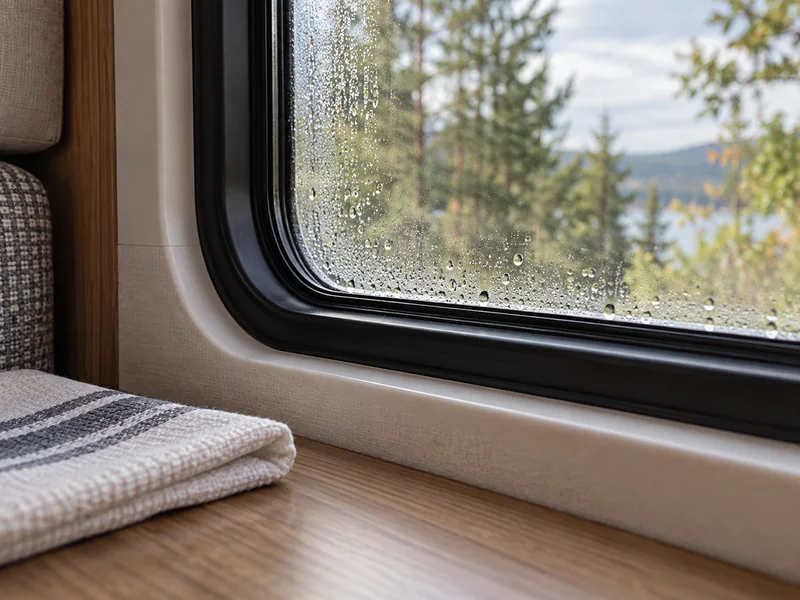
AI-generated illustration: Window droplets illustrate an observable wet surface; the image does not identify the moisture source or condition of hidden materials.
Record where RV moisture appears, when it happens and what the vehicle was doing. Use surface observations, consistent temperature and humidity readings, and the installed equipment's guidance to choose non-invasive responses. Recurring localized wetness, damaged materials or an unclear source need appropriate inspection rather than another covering or an assumed condensation fix.
Water on the inside of an RV window is an observation. Calling every damp patch condensation is a conclusion that needs more information. Moisture may relate to a cold surface, ordinary indoor activities, rain entry, plumbing or more than one source at the same time.
Start by recording the location, timing and conditions. Dry accessible wet surfaces appropriately, manage obvious moisture sources using the RV’s instructions, and check whether the pattern changes. If wetness recurs in one place or materials are deteriorating, arrange an appropriate inspection rather than hiding the area behind insulation, a liner or new trim.
This guide provides a non-invasive observation and maintenance process. It contains no measured RV moisture trial, structural diagnosis, mold identification or health assessment. The blank log is for your own readings, and the named manufacturers’ examples apply to the equipment they describe.
Understand what condensation can and cannot explain
Condensation occurs when water vapor becomes liquid on a sufficiently cold surface. A window frame or another cold part of the RV can collect moisture even when the room feels comfortable. The relevant conditions include both moisture in the air and the temperature of the surface.
Cooking, bathing, breathing and wet belongings can contribute moisture indoors. Winnebago’s condensation guidance also notes that enclosed cabinets and drawers can become damp. That makes accessible storage areas worth observing, not just the windows you can see from the seat.
A humidity reading in the middle of the RV does not identify the cause of a wet cabinet corner. Nor does the absence of window droplets prove there is no leak. Keep the observation and its possible explanation in separate columns so an early guess does not shape every later decision.
| Observation | Useful context to collect | What it does not establish | Next step |
|---|---|---|---|
| Droplets on an inside window after a cool night | Indoor conditions, occupancy and ventilation | That every damp area in the RV has the same cause | Dry the accessible surface and compare the next observation |
| Moisture after cooking or showering | Duration, exhaust arrangement and openings used | That adding any fan will solve the problem | Check the fitted equipment’s instructions and use |
| A repeatedly wet corner after rain | Exact location, rain timing and photographs | The route water took to get there | Arrange inspection if the source is unclear |
| Dampness beside plumbing or after water use | Which fixture was used and when | Whether moisture came from a connection or the surrounding air | Have the relevant system checked if unresolved |
| Damp belongings in enclosed storage | Item condition when packed and contact surfaces | That a container or moisture absorber is an adequate fix | Remove affected items and examine accessible surfaces |
| Staining, softness, lifting finish or persistent odor | Location, history and changes | The extent or type of concealed damage | Seek appropriate assessment before covering or disturbing it |
Use the table to decide what information is missing. Do not intentionally recreate a leak or operate a suspect system to strengthen the log. Existing observations are enough to begin a service conversation.
Respond to wet surfaces while recording the pattern
Do not leave an accessible wet surface untouched while waiting for several days of readings. Use a suitable clean cloth and the surface manufacturer’s care instructions to remove moisture. Move damp belongings to a place where they can be handled and dried appropriately. Keep electrical equipment and unfamiliar systems out of the improvised drying process.
EPA’s moisture guidance advises prompt drying and identifies a 24-to-48-hour response window for wet materials after a leak or spill. Treat that as urgency to address water, not as a guaranteed safe waiting period or proof that every material will be recoverable. The page concerns buildings; an RV’s construction and equipment require their own assessment.
If there is active water entry, a damaged material or an unclear source, arrange help appropriate to the affected assembly. Keep a record of what was wet before cleanup, but do not dismantle panels or disturb suspicious material just to obtain a more dramatic photograph.
Cleaning a visible patch and fixing the moisture source are different tasks. This article does not prescribe mold-cleaning chemicals, sampling or treatment for a health concern.
Build a consistent observation log
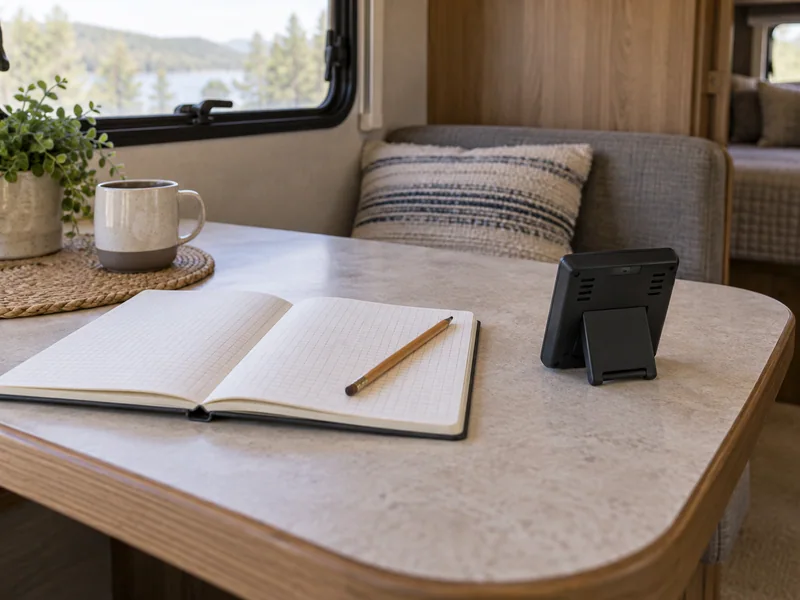
Choose a repeatable indoor location for a temperature and relative-humidity instrument, following its instructions. Avoid changing its location casually between readings. Record the location so a later reading from a colder corner is not mistaken for a change in the whole RV.
Take observations at useful moments, such as before bed, after waking and after a moisture-producing activity. These are opportunities to notice a pattern, not a required sampling schedule. If a condition needs immediate attention, act on it instead of waiting for the next entry.
Use the same units and note the source of outdoor conditions. A weather report, a sheltered outdoor sensor and the temperature displayed inside the vehicle are different measurements. If you have not measured something, leave it blank rather than estimating it into the record.
| Log field | Your entry | Detail that makes it useful |
|---|---|---|
| Date and time | ________ | Include whether the RV was occupied or stored |
| RV and parked location | ________ | Model and relevant exposure conditions |
| Exact wet surface | ________ | Inside/outside, side of vehicle and nearby features |
| Indoor temperature and RH | ________ | Instrument and placement |
| Outdoor temperature or weather | ________ | Source of the reading or observation |
| Recent activities | ________ | Cooking, showering, wet clothing or water-system use |
| Ventilation and heating/cooling state | ________ | Equipment, setting and openings used |
| Action taken | ________ | Drying, source reduction or service request |
| Follow-up observation | ________ | Same location, new conditions and any recurrence |
Photograph the same area from a similar position when possible, with context to identify it. You do not need to show an entire personal living space. A location label and a close photograph of the affected surface may provide a clearer record.
Read humidity numbers as context
Relative humidity describes moisture relative to what air can hold at its current temperature. Because temperature matters, a lower displayed RH after warming the room does not by itself prove that water was removed from the RV. Record temperature alongside RH.
EPA’s general indoor guidance recommends keeping humidity below 60%, ideally between 30% and 50% when possible. Those are useful reference values, not an RV-specific guarantee against condensation. A cold surface may still be wet, and an instrument reading does not rule out a leak or diagnose hidden materials.
Use the log to compare conditions, then follow the vehicle and equipment requirements. Do not pursue a single number by blocking required vents, sealing appliance openings or using a heater in a way the manufacturer does not permit.
If two instruments disagree, check their placement, stabilization requirements and stated accuracy before treating the difference as a vehicle problem. Avoid recording more decimal places than the instrument provides.
Match the response to an observed moisture source
For ordinary use, begin with source management and the ventilation already designed into the RV. The Winnebago Towables 2025 manual directs users to run the range hood while cooking and ventilate the bathroom while bathing. It also identifies wet clothing as a moisture source. Consult the corresponding instructions for your vehicle.
Check whether the fitted fan actually exhausts outside and what preparation it requires. Some equipment has covers, latches, filters or operating restrictions. Do not infer airflow from fan noise alone, and do not remove guards or reach into powered equipment to investigate.
| Situation | Non-invasive step to consider | Equipment or vehicle check | What to record afterward |
|---|---|---|---|
| Cooking introduces visible steam | Use the intended exhaust arrangement | Hood outlet, controls and manual requirements | Surface condition and indoor readings |
| Shower use leaves wet surfaces | Use bathroom ventilation and dry accessible surfaces | Fan operation and approved care of finishes | Whether moisture clears or returns |
| Wet clothes enter the vehicle | Use an appropriate drying arrangement outside closed storage | Garment care, campsite rules and RV guidance | Where the items dry before being stored |
| Air circulation around stored items is restricted | Reposition dry belongings in permitted storage | Keep required equipment clearances and access | Whether the same accessible area becomes wet again |
| A dehumidifier is being considered | Assess actual operating conditions and collected-water handling | Temperature range, power, placement and drainage instructions | Runtime, conditions and correctly measured water collection |
| Wetness remains unexplained | Preserve the log and request inspection | Vehicle and affected component documentation | Findings and the agreed follow-up |
Do not add insulation or drill ventilation holes based only on a wet patch. Those changes can affect the assembly and conceal the evidence needed to understand it.
Check the exact fan, not just the brand
Maxxair’s MAXXFAN Deluxe page identifies a built-in rain shield for that product family. That is a specific feature, not permission to leave every RV roof vent open in rain. Locate the model number and read its operating instructions before choosing an opening or fan setting.
Record the effect of the ventilation arrangement you actually use. Outside conditions, openings and the RV’s activity can change between nights, so a better result does not prove one change was solely responsible. Make a modest operational change within the instructions, then note the conditions rather than announcing that a product cured the problem.
For a portable dehumidifier, plan where the collected water goes, how the unit is powered and how it is secured or stored when traveling. A passive moisture absorber also needs product-specific handling and spill protection. Neither should replace attention to an active leak, and this guide ranks neither approach by untested performance.
Include beds, closets and the storage period
Check accessible mattress edges and the surfaces around bedding as part of the ordinary packing routine, without dismantling the bed or obstructing supports. Keep belongings from blocking access you need for observation and maintenance. The sleeping-layout guide helps preserve access while the bed is in use.
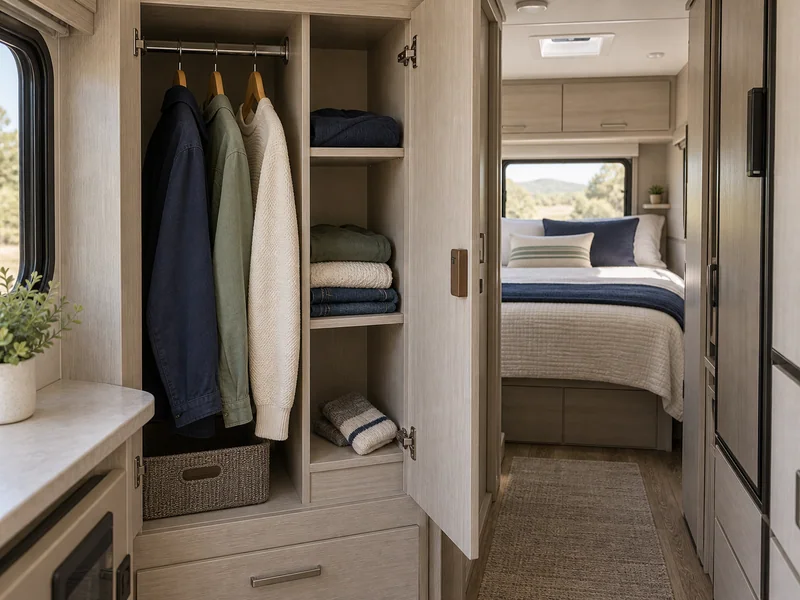
Clothing that entered storage damp creates a different problem from a dry garment becoming damp later. Note that distinction. The closet and laundry guide gives wet items a separate route so they are not buried among ready-to-wear clothes.
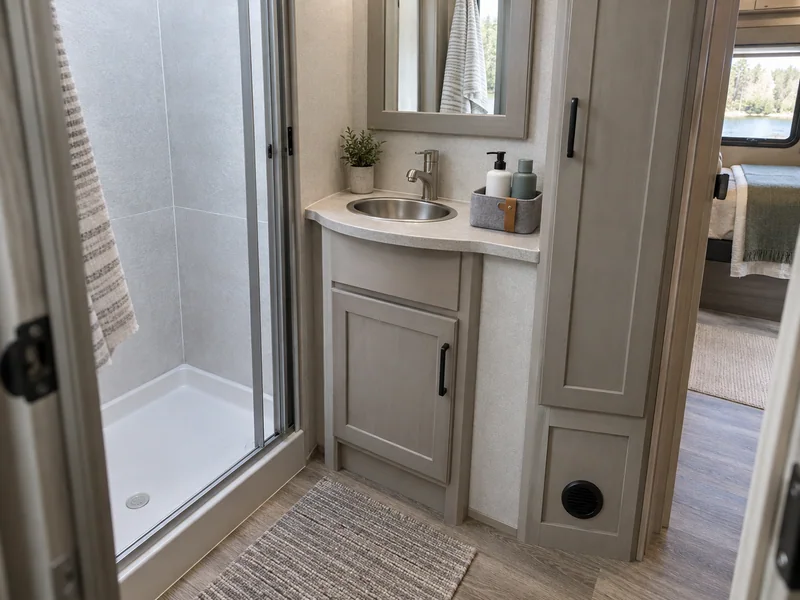
In the bathroom, keep wet towels and wash items in an appropriate routine rather than closing them inside a crowded cabinet. Use the bathroom storage guide for access and return locations.
Before leaving the RV in storage, follow its storage procedure and inspect accessible areas for moisture. Do not assume a ventilation setting suitable while occupied is also the approved unattended arrangement. Secure openings and equipment according to the manual, weather exposure and storage-site requirements.
Prepare a useful service handover
Bring the RV identification, relevant component model numbers, a short event timeline and photographs of the specific locations. Include what you dried or changed and whether the moisture returned. This is more useful than a long shopping list of products already tried.
Ask which sources and assemblies were inspected, what remains uncertain and what follow-up is needed. Keep any repair record with the log. A short period without droplets is an observation, not proof that concealed damage has been ruled out.
You can locate model-year information through resources such as Winnebago’s operator-manual library. Use the document for your own RV and installed components. The goal is a traceable account of moisture and a suitable response, with unresolved conditions still visible to the person assessing them.
Sources & further reading
Use these original sources for the full context and the latest guidance.
- EPA: A brief guide to mold, moisture and your home (opens in a new tab)
- Winnebago: Condensation prevention in your RV (opens in a new tab)
- Winnebago Towables: Model Year 2025 owner's manual (opens in a new tab)
- Maxxair: MAXXFAN Deluxe model features (opens in a new tab)
- Winnebago: Operator manuals by model year (opens in a new tab)
Prepared with AI assistance. Read our editorial approach.
This is a researched planning guide, not a report of a hands-on product test.
Last updated .