RV Closet Organization for Clothes You Actually Pack
Organize an RV closet around your clothing, shelf dimensions, and laundry routine. Compare hanging and folded storage while keeping frequently used items accessible.
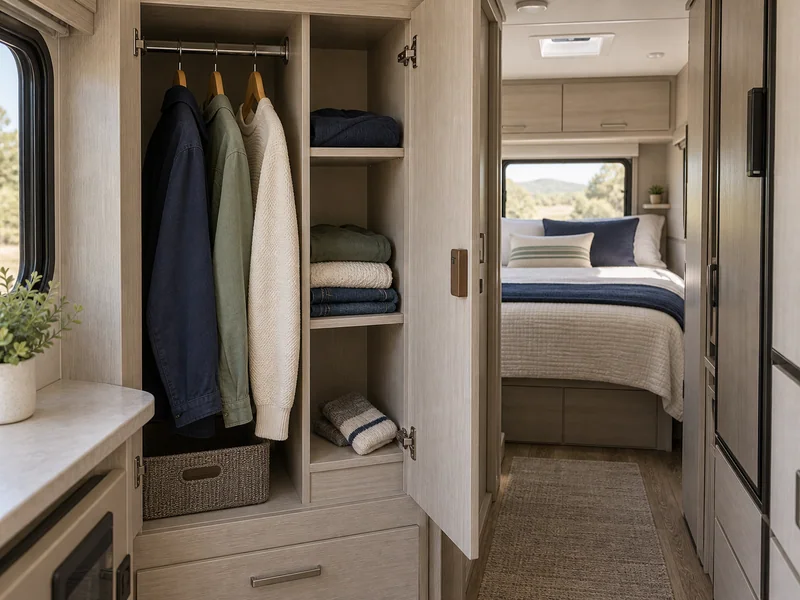
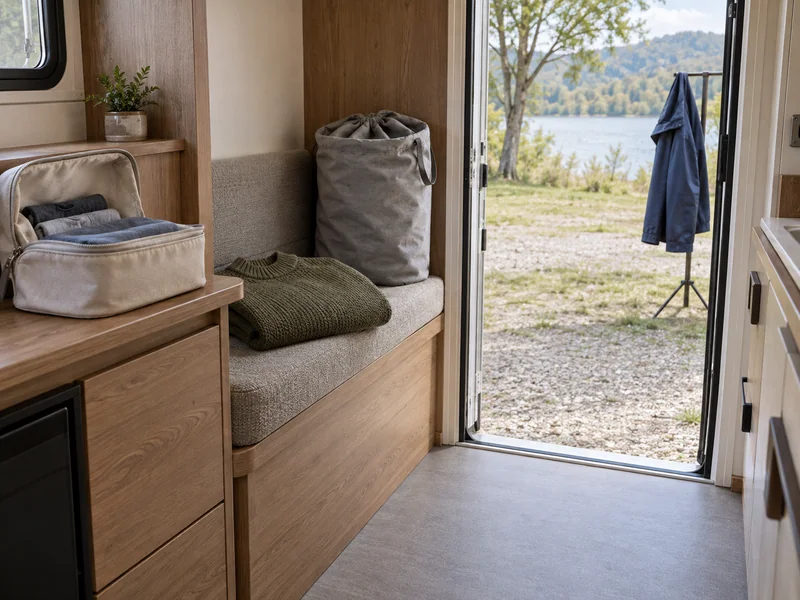
AI-generated illustration: A wardrobe concept combines a short hanging row with folded groups, using a modest ordinary clothing inventory.
Start an RV closet plan with the clothes needed between dependable laundry opportunities. Give clean clothing, items you will wear again, dirty laundry and damp layers separate destinations. Compare folded and hanging arrangements using the same inventory, then rehearse dressing, laundry day and travel closure.
An RV closet has to hold more than clean clothes on departure morning. As the trip progresses, those clothes become an outfit for tomorrow, a layer worth wearing again, a dry laundry load, or a damp jacket that needs attention. A closet arranged only for the first state will become crowded even when the total number of garments has not changed.
Start with the interval between dependable laundry opportunities. Build a clothing inventory for that interval, then give each stage of use a destination. After that, compare hanging and folded storage using the actual clothes you intend to take.
The worksheets below are planning tools, not a universal packing list. Clothing needs, access requirements, wardrobe dimensions and laundry facilities vary. No closet or set of garments was measured for this researched guide.
Plan from the next dependable laundry opportunity
Write the first realistic place you can wash and dry clothes, not simply the first campground with a laundry icon. Check access hours, whether the facility is available to you, and whether a broken or busy machine would leave you without suitable clothing. Keep those trip-specific details in your notes rather than assuming they remain constant.
For an onboard machine, identify the exact model and its operating requirements. A washer-dryer does not eliminate the need for dirty-laundry storage or drying time. It also needs the appropriate utilities and drainage arrangement for the installed system.
For example, the Splendide WDV2200XCD manual distinguishes wash and dry load sizes in its cycle table. It also says actual cycle duration varies with factors including load and water conditions. That is a reason to plan the laundry task as a sequence, with room for clothing between stages, rather than treating one basket as one guaranteed quick cycle.
Build the inventory around activities: sleeping, ordinary camp days, wet-weather outings, warmer or colder conditions, and any work or event requiring different clothing. Choose familiar garments that fit those jobs. Shared colors or interchangeable layers can simplify selection, but do not remove a useful weather layer merely to make a shelf look tidy.
| Clothing group | Use before laundry | Quantity you choose | Care or drying issue | Storage priority |
|---|---|---|---|---|
| Underwear and socks | Your normal change routine | ________ | Wash and dry according to labels | Easy daily access |
| Everyday tops and bottoms | Planned activities and repeat wear | ________ | Separate items with different care needs | Near the front |
| Sleep clothing | Bedtime and morning access | ________ | Keep a usable set available during laundry | Reachable with bed occupied |
| Warm layers | Expected conditions and backup need | ________ | Bulky or slow-drying garments need a plan | Accessible without unpacking reserve clothing |
| Rainwear and outdoor layers | Forecast and likely exposure | ________ | Drying and care instructions | Separate return route from clean clothes |
| Activity or occasion clothing | A specific planned use | ________ | Hanging, folding or specialist care | Match access to timing |
| Extra clothing for a delay | Your chosen contingency | ________ | Reserve must remain usable | Clearly marked reserve position |
Do not turn the blank quantity column into somebody else’s fixed clothing formula. A person who washes frequently may choose a different inventory from someone moving between remote sites. The useful question is whether the plan still works if the expected wash is delayed.
Give clothing four destinations
Use a clean zone for ready-to-wear garments. Keep it straightforward to see what remains, particularly socks and other small items that disappear beneath stacks.
Create a small, clearly defined place for clothing you intend to wear again. A dry sweater does not necessarily need to join the laundry after one brief use, but placing it across the only seat does not make it easy to manage. Choose a fitted shelf, an appropriate hanger, or another existing storage position that stays clear of controls and moving furniture.
Dry dirty laundry needs a collection point and a route out of the RV. Size the collection method for your planned washing interval and your ability to carry it. Two manageable bags can be easier to handle than one large hamper, although the fit and filled weight need checking with your clothes.
Damp clothing needs an appropriate drying arrangement before being put away. Do not seal wet layers into the clean wardrobe and assume a scented sachet will solve the problem. The Winnebago Towables 2025 manual identifies soaked clothing as an indoor moisture source and advises against hang-drying wet clothes inside its trailers. Use the instructions for your RV and the actual drying facilities available.
The separation can be simple. It does not require four matching organizers. Labels on existing containers or defined shelf areas may be enough if everybody understands which destination is which.
Measure clothes as well as the closet
Take out the intended garments and fold them the way you normally would on a trip. Measure the resulting groups, including any packing pouch. A tightly compressed stack made for a photograph is a poor test if the everyday fold occupies more space.
For hanging clothes, measure the hanger and the garment together. Check shoulder width, length below the rail, and clearance from the door. A low rail can leave a jacket bunched on the floor. A deep hanging organizer can block the rear half of the wardrobe or press against the door when loaded.
Use the actual door opening, not the outside cabinet dimensions. Include hinges, latches, sliding door overlap, drawer movement and the space where your hands need to go. Record any existing rail or shelf rating from the RV documentation or fitted label.
| Fit check | Your wardrobe | Your clothing or organizer | Decision |
|---|---|---|---|
| Clear shelf width and depth | ________ | Folded group: ________ | Can one group be removed independently? |
| Shelf height at opening | ________ | Normal stack height: ________ | Is there room to lift clothing out? |
| Rail to floor or lower shelf | ________ | Longest hanging garment: ________ | Does it hang without bunching? |
| Door opening and overlap | ________ | Hanger or pouch width: ________ | Can it pass through without distortion? |
| Floor or hamper opening | ________ | Filled laundry bag: ________ | Can you remove it when full? |
| Shelf, rail and attachment guidance | Source: ________ | Organizer plus contents: ________ | Is this use supported? |
Compare folded and hanging storage with the same inventory
Hanging storage keeps some garments visible and avoids making a tall stack. Folded storage can suit small items and clothing that does not need a hanger. Neither is automatically more space-efficient in every closet.
Try two layouts without changing the clothing list. In one, hang the garments that benefit most from it and use the shelf for small folded groups. In the other, fold more of the same clothing into existing drawers or pouches. Photograph or sketch both yourself and record which items are harder to reach.
| Arrangement | Can help with | Costs space or effort when | Rehearsal |
|---|---|---|---|
| A short row of appropriate hangers | Shirts, jackets or occasion clothing | A garment is longer than the clear hanging space | Remove a middle garment and return it |
| Folded groups standing in a drawer | Seeing individual tops or small garments | Drawer depth exceeds comfortable reach | Find one item without lifting the whole group |
| Shallow stacks on a shelf | Clothing that holds its folded shape | A bottom garment is needed every day | Take the bottom item and rebuild the stack |
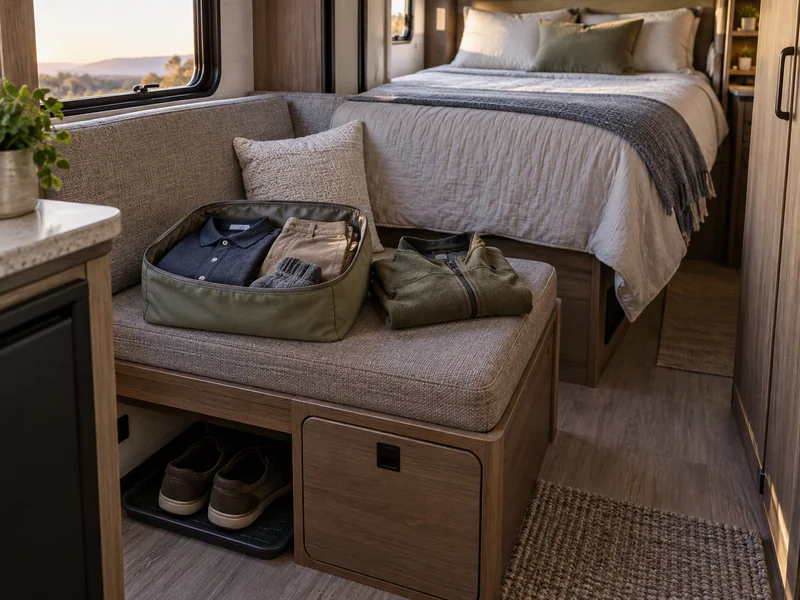
| Individual clothing pouches | Keeping each person’s belongings together | Opening several pouches hides the remaining inventory | Get a complete outfit in normal lighting |
| A removable laundry bag | Carrying washing out to a facility | The filled bag no longer passes the doorway | Test removal with the expected laundry load |
Manufacturer floor plans show why layouts need separate checks. Jayco’s 2027 Pinnacle lists a front wardrobe and a built-in laundry hamper on selected models. That does not establish that every RV has a hamper opening or a spare hanging rail. Start from your own fitted spaces rather than attempting to recreate a feature from a different floor plan.
Treat hooks and hanging shelves as attachments
An adhesive hook can be convenient for a light item when its surface, environment and instructions are suitable. It is not a universal travel restraint or a substitute for checking a wardrobe rail’s load guidance.
Command’s hook instructions distinguish indoor and outdoor products and specify temperature ranges, surface preparation and prohibited uses. They warn against hanging over beds or on wallpaper. Many RV finishes are unfamiliar to a household-product buyer, so identify the surface and consult both instructions before applying anything.
Do not multiply a stated hook capacity by adding more hooks and call the result a verified load allowance. A hanging shelf also transfers the weight of its contents to whatever supports it. Check the intended use of the rail, hook or bracket and allow for travel according to the RV’s guidance.
Rehearse laundry day, not just departure day
Place the clothes you expect to wash into the chosen bag. Add the laundry supplies you actually use, kept in their appropriate labeled containers and separate from garments where needed. Work through carrying the load out, sorting it, washing, drying, folding and returning it.
Read garment labels before grouping a load. The Splendide manual explicitly directs users to those labels; a machine’s available cycle does not make it suitable for every fabric. Keep garments requiring another process separate so they do not disappear into a mixed load at the last minute.
Reserve a clear place for clean clothes to return. If the only folding surface is the bed, plan around when somebody is using it. If washing finishes late, keep the next sleep outfit accessible instead of storing it beneath everything being sorted.
Count laundry bags as part of the storage plan even when they are empty. Their handles, liners or collapsible frame still need somewhere to go. Store laundry products by their labels and keep appliance service access and ventilation clear.
Make dressing possible with the bed still in use
Set aside the next outfit when the closet will be difficult to reach in the morning. A single accessible outfit can resolve a daily conflict more effectively than reorganizing every shelf. Include the outer layer and footwear needed to leave the vehicle so the preparation is complete.
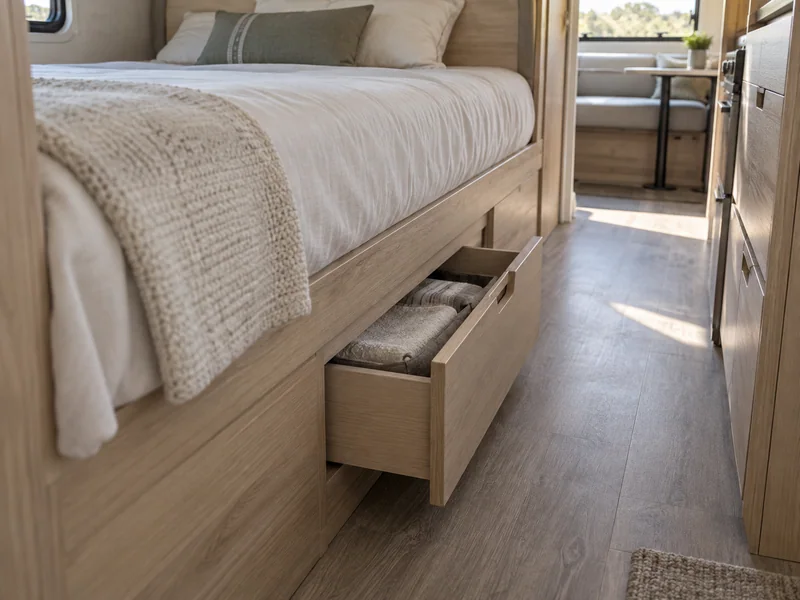
If reserve clothing goes beneath the bed, use the under-bed access worksheet to check its route. Keep daily clothing out of a lift-only compartment when retrieving it would disturb another sleeper. Towels and toiletries belong in the bathroom routine where their use and drying can be planned together.
Before travel, remove temporary hanging arrangements that the vehicle or product instructions do not permit in motion. Close and latch wardrobe doors and drawers, then check that nothing is caught in a slide or furniture movement path.
Keep a clothing and laundry card
Use this card after the first trip rather than buying more organizers immediately:
- Planned laundry opportunity and backup: ________
- Clothing carried but never needed: ________
- Clothing unavailable when needed: ________
- Largest dry laundry load before washing: ________
- Where damp clothing went: ________
- Clothes that needed different care: ________
- The item hardest to retrieve: ________
- One change for the next trip: ________
Repeated dampness or a musty storage area needs attention beyond folding. Record where and when it appears in the RV condensation and moisture log. A successful closet arrangement keeps usable clothing accessible through the entire trip, including the journey back from the laundry.
Sources & further reading
Use these original sources for the full context and the latest guidance.
Prepared with AI assistance. Read our editorial approach.
This is a researched planning guide, not a report of a hands-on product test.
Last updated .