RV Under-Bed Storage That Keeps Essentials Reachable
Plan RV under-bed storage by opening size, access, and the items you use each day. Measure the compartment and compare bins, dividers, and loading routines.
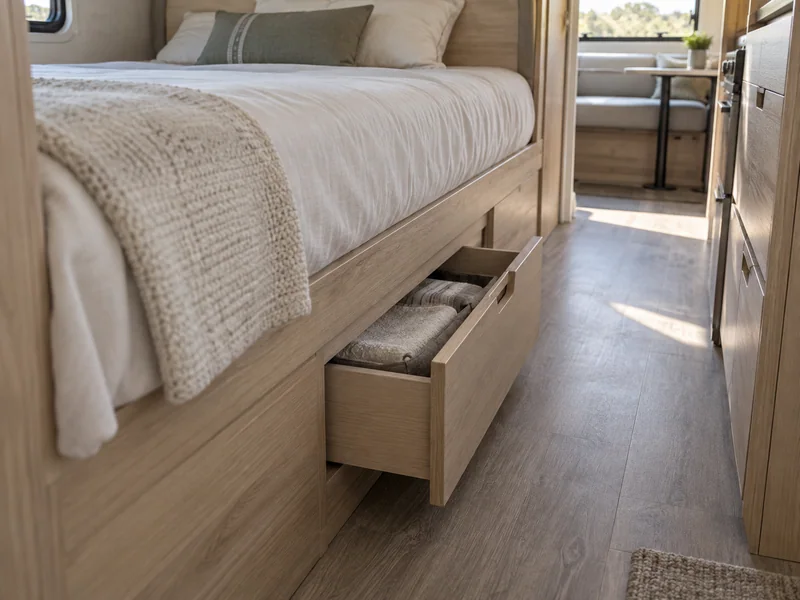
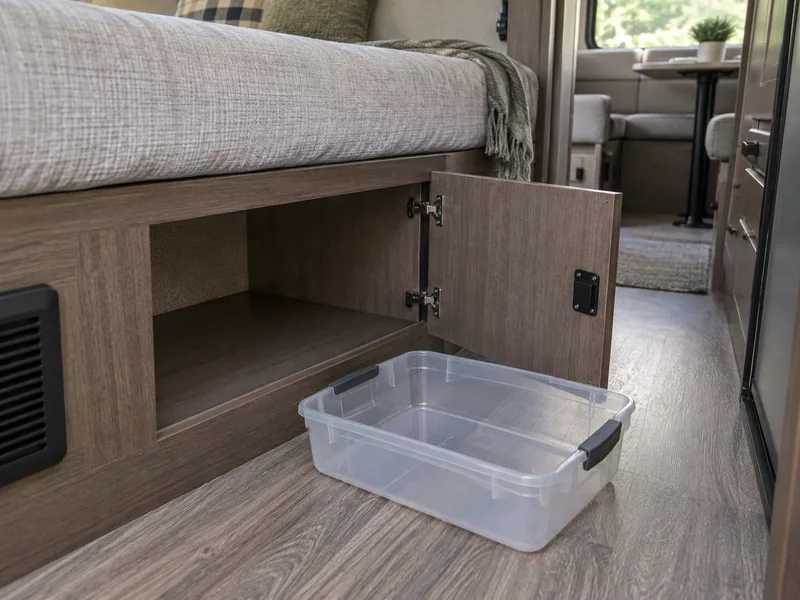
AI-generated illustration: An existing side drawer illustrates access beneath a fixed bed without raising the sleeping platform.
Arrange an existing under-bed compartment around the route each item takes out. Check the bed's support and moving parts, measure the narrowest opening, and give frequently used belongings a location you can reach without clearing the bed. Compare containers using your own packed items, including their return to storage.
A spare blanket can live beneath a mattress quite happily until someone needs it while another person is asleep. A large bin can fit inside the bed base but refuse to pass through its hatch. Useful RV under-bed storage depends on the whole retrieval path, including the person using it.
Start with the bed you already have. Identify how its storage opens, what supports the moving platform, and which belongings you can reach with the bed made. Then allocate storage by the effort needed to remove and return an item. Reserve difficult access for belongings you use less often.
This researched guide provides a measurement and packing method. It does not supply a bed construction plan, tested compartment dimensions, or a load rating for your furniture. If you are choosing between fixed and convertible beds, begin with the campervan sleeping-layout comparison.
Identify the access you actually have
Under-bed storage can mean several different things: a platform that lifts from the foot, a narrow side hatch, drawers below the mattress, or an open rear garage. Those designs do not offer the same access simply because they occupy a similar part of a floor plan.
Manufacturer descriptions demonstrate the distinction. Jayco’s 2027 Pinnacle equipment list specifies gas-strutted under-bed storage. That describes the fitted arrangement; it does not supply the opening dimensions or authorize adding weight to the platform. Check the actual model and installed equipment before choosing containers.
| Existing access | What to observe | Candidate contents | Main packing constraint |
|---|---|---|---|
| Platform lifting from the foot | Mattress movement, lift support, room to stand | Dry spare bedding or occasional clothing | A container must clear the raised edge without entering the hinge area |
| Side hatch or door | Door swing, threshold, reach around the corner | A small daily kit within easy reach | The opening can be much smaller than the cavity |
| Built-in drawer | Full travel, internal height, latch operation | Folded clothing or small grouped belongings | Handles and protruding contents can prevent closure |
| Rear access beneath a fixed bed | Door opening and the route past other gear | Items used outdoors, where appropriate | Travel restraint and vehicle loading still govern placement |
| Seat or bed base with removable panels | Panel handling and a safe place to put it | Infrequent dry supplies | Retrieval may require dismantling the daytime or nighttime arrangement |
Draw the opening as well as the cavity. Mark hoses, wiring, ducts, supports, service panels and any unknown enclosure. Leave unknown areas unassigned until you identify their purpose. An empty-looking corner may belong to a mechanism or a service route.
Check support before putting hands inside
Use the bed’s own operating instructions to open and support it. Do not assume that an unfamiliar gas strut is working correctly, add a makeshift prop, or change the mattress and then assume the lift system still behaves as designed. Stop if the platform does not remain supported as its manual describes.
The 2022 Jayco Eagle fifth-wheel manual distinguishes models with a prop rod from models with gas struts. Its prop-rod procedure includes assistance from a second person. That model-specific example explains why a generic instruction to lift the mattress and reach inside is incomplete. Obtain the correct handbook for your year and bed equipment rather than borrowing its procedure for a different RV.
Keep fingers, clothing, straps and loose bedding clear of the hinge and closing path. Perform measurements from a stable position with the platform supported as instructed. If you cannot reach a measurement without placing yourself beneath an uncertain support, leave it blank and have the arrangement checked.
A support problem is a maintenance task before it is an organizing task. Buying a shallower bin will not resolve a platform that drops, twists or catches.
Measure the narrowest part of the journey
Record dimensions in one unit throughout. Measure the container outside, including its lid, handles and any parts that project when opened. The volume printed on a box describes capacity inside the box, not the space required to retrieve it.
Think of removal as three movements: entering the opening, passing the threshold, and turning into the room. A long container may pass straight through a hatch but be impossible to rotate between the bed and the wall. A soft bag may pass empty and bulge beyond the opening once filled.
| Measurement or observation | Your result | What the result controls |
|---|---|---|
| Narrowest clear width of opening | ________ | Maximum container width at the point of entry |
| Clear height at opening, bed safely supported | ________ | Lid, handle and packed-bag clearance |
| Usable floor depth to the first obstruction | ________ | How far a container can slide inward |
| Depth you can retrieve comfortably | ________ | Position of frequently used belongings |
| Threshold or lip height | ________ | Whether a filled container must be lifted before removal |
| Space outside the opening | ________ | Turning, standing and setting the container down |
| Hinge, support and service areas to keep clear | ________ | Space that cannot be occupied by storage |
| Furniture or compartment loading guidance | Manual/page: ________ | Permitted storage use and attachment limits |
Use a light, empty container for the first fit check. Once the route is established, try the intended contents in a stationary RV without exceeding any applicable limits. Observe whether you can use both hands and whether the lid catches. Do not use the hatch edge or a service panel as a lifting support.
Assign items to three retrieval groups
Put an item in the first group if someone may need it while the bed is occupied. Glasses, a light, a warm layer and the next morning’s clothing belong in an accessible location outside a lift-only compartment. The correct home may be a fitted bedside cubby or existing drawer, not beneath the mattress.
The second group contains things used during the day that can be retrieved while the bed is clear. Give these items the near edge or an independently opening drawer. Keep each task together: a bedding-change bag might hold clean sheets and pillowcases, while clothing for a particular activity can have its own pouch.
The third group is reserve storage. A dry spare blanket or a seasonal clothing bag can use a less convenient position if it remains reachable without disturbing equipment. Avoid filling every remote corner simply because it exists. Retain the access needed for inspection and removal.
For two travelers, allocate space by retrieval need rather than automatically splitting the compartment in half. The person leaving early needs access to their morning kit. A shared bedding reserve can sit farther back even if one person owns most of it.
Choose a container for removal and return
Rigid bins, soft bags and dividers solve different problems. Compare them using the same possessions. Otherwise, a tidy result may simply reflect leaving half the inventory on the floor.
| Arrangement | Useful when | Tradeoff to rehearse | Return check |
|---|---|---|---|
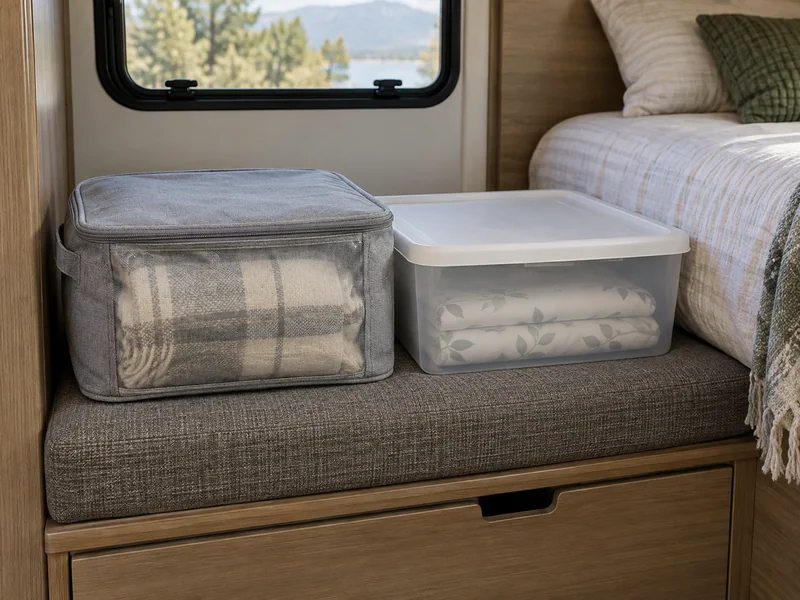
| Shallow rigid bin with lid | Contents need protection and a defined boundary | Lid and handles take space at the opening | Can it be closed without compressing bedding into the hinge path? |
| Soft zip bag | Flexible dry items need grouping | A full bag can bulge and lose its shape | Does the zipper close after a normal, imperfect fold? |
| Separate small pouches | Several small tasks share one compartment | Too many similar bags can hide the item you need | Can you recognize each pouch from the access edge? |
| Existing drawer with removable dividers | Small items scatter during use | Dividers reduce usable space and need suitable retention | Does the drawer latch with everything in its place? |
| Large undivided container | One bulky, infrequently used group belongs together | Its filled weight and awkward reach may make removal difficult | Can you lift and carry it without emptying it first? |
A long handle is useful only if the container itself tolerates being moved that way. Do not pull on an unreinforced bag seam or use a strap that can catch in a bed mechanism. A container that needs dragging across plumbing or wiring is in the wrong position.
Compression bags can reduce the size of some soft belongings, but their packed form and access requirements still need checking. Record whether reopening the bag creates a repacking task you can actually repeat on the trip. Do not assume a vacuum bag can be compressed again when the equipment used at home is unavailable.
Keep loading and attachment decisions separate
The available space is not a weight allowance. Count the organizer itself as well as its contents, and consult furniture, compartment and vehicle guidance separately. A bed’s sleeping capacity does not automatically describe what may be stored beneath it or attached to its underside.
The Winnebago Towables 2025 manual includes clothing and other cargo in its vehicle loading discussion. That is the relevant distinction: moving belongings into a hidden cavity does not remove their weight from the RV. Resolve weight and distribution using your actual labels and loaded vehicle, not a storage photograph.
Start with an arrangement that uses existing approved storage features. Adding drawer slides, a lift kit, screws, brackets or a new access opening changes the project. Record the intended load and location and obtain suitable guidance for the structure and equipment involved. This article does not specify fasteners or strut force.
Run a complete access rehearsal
Choose three realistic tasks: retrieving tomorrow’s clothes, changing bedding, and removing an occasional item. Make the bed as it would be used, close other furniture, and place nearby travel bags in their usual homes. Then complete each task, including putting everything back.
Write down what you moved aside, where you set it, and what stayed inaccessible. Count disturbed containers if that helps compare arrangements. Your own count is more useful than a promise that a particular bin will save time.
Repeat the hardest task after changing only the item order or one container. If it remains awkward, move that item to a different storage zone. The whole-RV storage map helps decide where, and the closet guide handles clothing and laundry needs in more detail.
Before travel, return the bed, drawers and latches to their required positions. Confirm that nothing projects into the closing path. After the next trip, review the arrangement for shifted contents, chafing or dampness. If moisture appears, remove affected belongings and use the RV moisture observation guide to record the conditions before concealing the area with another liner or box.
Your under-bed packing record
Copy this short record for each container. Keep it with your RV notes so a future packing change does not erase the original reasoning.
- Container and contents: ________
- Access opening and travel position: ________
- When the contents are needed: ________
- Items moved during retrieval: ________
- Where the container is set while open: ________
- Support, service and loading guidance checked: ________
- Fit with normal contents and lid closed: ________
- Change to make after the next trip: ________
Keep the arrangement that makes the important items easy to retrieve and return. Unused space is acceptable when it preserves a clear hinge path, service access or a manageable lifting task.
Sources & further reading
Use these original sources for the full context and the latest guidance.
Prepared with AI assistance. Read our editorial approach.
This is a researched planning guide, not a report of a hands-on product test.
Last updated .