RV Pantry Organization for a Small Food Supply
Organize an RV pantry around meal plans, package sizes, and easy access. Build a shelf inventory and restocking routine that fits the storage you actually have.
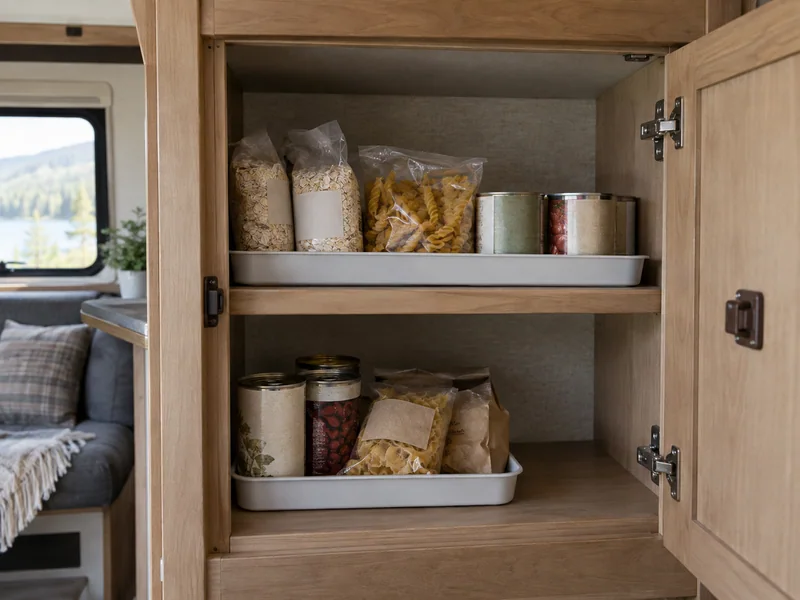
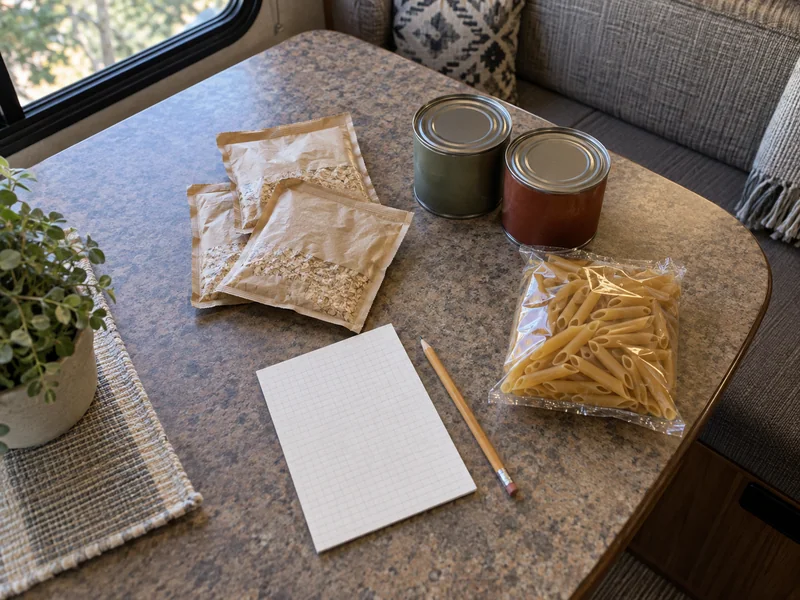
AI-generated illustration: A small pantry supply grouped for access leaves room to distinguish current ingredients from unopened reserve.
Give every pantry item a known quantity, storage state, and next use. Keep opened food visible, record what leaves the shelf, and restock from verified supplies rather than a quick glance at the cabinet.
Know what is on the shelf before buying more
An RV pantry works best when you can answer three questions: What is here? How much is usable? Which meal will use it next? Clear containers can help you see food, but they cannot answer all three without a current record.
Start with the food you actually carry. Keep one inventory for the RV, including any food you move temporarily into the refrigerator or take back into the house. A cabinet can look full while containing very little of what the next trip needs.
This guide is a stock-management method for a small traveling pantry. Its forms are blank for your own shelf measurements and package labels. The worked stock example is hypothetical, not a measured household inventory or a tested menu.
If you have not selected a food-storage zone, use the whole-RV storage map first. Once that location is suitable, the job here is to keep the food moving through it without losing track of open packages, reserve supplies, or items that no longer belong on the shelf.
Make the first inventory in units you can count
Remove food from one shelf at a time while parked. Read each label and note its storage directions. Group identical unopened products only when their package size and relevant instructions match. “Three rice packages” is an incomplete record if each package contains a different amount.
Choose a useful unit for each item: individual packets, cans of a stated size, ounces, or another measurable amount. Keep that unit consistent in the stock record. A half-full jar seen through the door is an estimate; write “unverified” until you have checked what remains.
Record opened food separately from unopened reserve. Opening can change the required storage conditions. The FDA advises checking storage directions on labels, including for foods that may not seem obviously perishable. A place in the pantry does not override those instructions.
| Stock field | What to write | Why it matters |
|---|---|---|
| Product identity | Exact food and relevant package size | Prevents treating unlike packages as equal |
| Counting unit | Packets, cans, ounces, or another stated unit | Keeps additions and use comparable |
| Unopened quantity | Verified count | Shows reserve that has not changed storage state |
| Opened quantity | Amount checked and date opened | Separates partial packages from full ones |
| Required storage | Instructions from the actual label | Determines whether the food can stay on the shelf |
| Current location | Shelf, refrigerator, or home | Prevents searching for food that moved |
| Next intended use | Named meal or trip | Gives the food a reason to remain packed |
Set aside items whose identity, condition, or storage history is uncertain for an appropriate food-safety decision. Do not put them in the “use first” group simply to clear space. That group is for food you have established can be used, not food you are unsure about.
Give each shelf a small, readable record
Assign shelf names that are easy to say, such as K1 and K2, or upper-left and lower-right. Match those names on the stock sheet. You do not need a barcode system for a few packages, but you do need everyone to use the same location names.
Carry over your actual usable shelf measurements. If the opening, hinges, or removal space still need checking, use the RV kitchen cabinet measurement guide. Avoid duplicating those measurements in several notebooks that may drift out of date.
| Shelf | Usable space from your measurement | Food and counting unit | Verified amount | Opened status and storage instruction | Next meal | Restock note | Travel check |
|---|---|---|---|---|---|---|---|
| ___ | ___ | ___ | ___ | ___ | ___ | ___ | ___ |
| ___ | ___ | ___ | ___ | ___ | ___ | ___ | ___ |
| ___ | ___ | ___ | ___ | ___ | ___ | ___ | ___ |
Choose containers only after you know the packages and their access needs. A large matching bin may hide several different foods behind one label. Two smaller task groups may be easier to keep accurate, provided the resulting arrangement fits and meets the storage requirements of your RV.
Do not pack a shelf to a guessed load limit. Canned food and other dense supplies count toward the actual cabinet and vehicle load. The Winnebago Towables manual’s travel guidance calls for securely stowing cabinet contents. Use your own model’s limits and restraint instructions when assigning those contents to a shelf.
Separate current food, reserve, and food that moves
Give the next usable package an obvious position. Keep unopened reserve distinguishable so someone does not start a second package without checking the first. This can be a location or a label; it does not require another purchased organizer.
Use a short “current food” list for items that already have an assigned meal. A package left in reserve should have an identifiable reason to travel too, such as a planned backup meal. If it repeatedly comes home untouched, reconsider the amount rather than automatically topping it up.
Food that changes location needs a note. When an opened package requires refrigeration, move it promptly as its label requires and change the record to its new location. The pantry sheet can still tell you that it exists without implying that it remains safe at room temperature.
The shelf-stable camping food guide explains the package and opening checks involved in choosing these foods. Here, retain the result of that decision beside the stock entry. You should not have to repeat the full label research every time you count supplies, but you should recheck a replacement product or changed label.
Record movement when it happens
A stock sheet stays useful when updates are small. After a meal, record the quantity used, any change from unopened to opened, and any new storage location. At the end of a trip, record what goes back to the house. Food at home should not remain listed as available in the RV.
Do not count food reserved for another meal twice. If two meals share an ingredient, identify the quantities assigned to each in your menu, then record the combined requirement in the pantry note. The one-pan meal planning worksheet can help connect an ingredient to an actual cooking plan.
Use this compact movement log when several people share the pantry:
| When | Food and unit | Added | Used or removed | Amount now verified | New location or opened status | Initials |
|---|---|---|---|---|---|---|
| ___ | ___ | ___ | ___ | ___ | ___ | ___ |
| ___ | ___ | ___ | ___ | ___ | ___ | ___ |
| ___ | ___ | ___ | ___ | ___ | ___ | ___ |
A worked stock example with stated assumptions
Assume, for this example only, that you carry individually sealed oatmeal packets and their labels permit your planned storage. You count in packets. The quantities below demonstrate bookkeeping, not recommended portions, shelf life, or the right food allowance for a trip.
| Event | Quantity change | Verified packets remaining | Planning note |
|---|---|---|---|
| Initial count | 12 packets present | 12 | Counted individually |
| Food used during the trip | 4 packets used | 8 | Update after use |
| New plan assigns 6 packets plus a chosen reserve of 2 | No physical change | 8 | Requirement is 8, so no shortage |
| Before departure, 3 packets are taken into the house | 3 packets removed | 5 | RV stock no longer meets the requirement |
| Restock record updated | No purchase recorded yet | 5 | Shortage is 3 packets |
The final line is deliberately not “8 packets remaining.” A shopping intention is not stock. Add the replacement quantity only after it is actually packed, and record any surplus created by the retail package size.
Set the restock check around your next trip
You can use a simple threshold for a food you carry repeatedly: the amount assigned to the next trip, plus any reserve you deliberately choose. Compare that with verified usable stock. If the stock is lower, record the shortfall in the same unit.
Keep the reserve modest enough to fit the approved space and your actual use. There is no universal number of backup meals that suits every route, storage setup, or group. Reserve is a planning choice, not permission to ignore package instructions or vehicle limits.
Hand the verified shortfall to your camping grocery list worksheet. That guide handles combining a menu into shopping quantities and retail packages. The pantry record should supply accurate starting stock, not become a second competing shopping list.
Before adding replacements, check whether the next trip still needs the item. A changed menu can remove a shortage without any purchase. If someone bought a different package size, update the unit or convert it explicitly before adding it to the count.
Keep stock decisions separate from safety decisions
Do not use a stock rotation rule as a substitute for label instructions and temperature control. “Oldest first” can help you find suitable food that needs using, but it cannot make damaged or improperly stored food suitable to eat.
The FDA’s storage guidance advises keeping food away from household chemicals and checking canned goods for damage. Maintain that separation when choosing a shelf or a container, even if the cleaning products would fit neatly beside the cans.
Use the camping food storage guide for refrigeration, time limits, and food handling decisions. Keep those rules with the meal process instead of inventing a pantry-wide expiry date. A best-quality date, date opened, and “needed for Saturday dinner” note serve different purposes and should have separate fields.
Close the trip with a short pantry reset
- Count what actually remains, using the unit already on the sheet.
- Update open packages and their required storage locations.
- Remove food that should return home and record the movement.
- Review packages and shelf condition before adding replacements.
- Keep cleaning supplies separate from food.
- Reconcile the next menu with verified stock before shopping.
- Add purchases to the count only when packed.
- Check the loaded shelf and its travel restraint using the vehicle instructions.
Keep the most recent sheet where the person packing can see it. When the record becomes difficult to maintain, shorten it to the fields you actually use. An accurate record of a small supply is more useful than a detailed inventory nobody updates.
Sources & further reading
Use these original sources for the full context and the latest guidance.
Prepared with AI assistance. Read our editorial approach.
This is a researched planning guide, not a report of a hands-on product test.
Last updated .