Pop-Up Camper Renovations with a Clear Project Scope
Plan a pop-up camper renovation by condition, budget, weight, and daily use. Separate cosmetic work from repairs that need qualified inspection or specialist help.
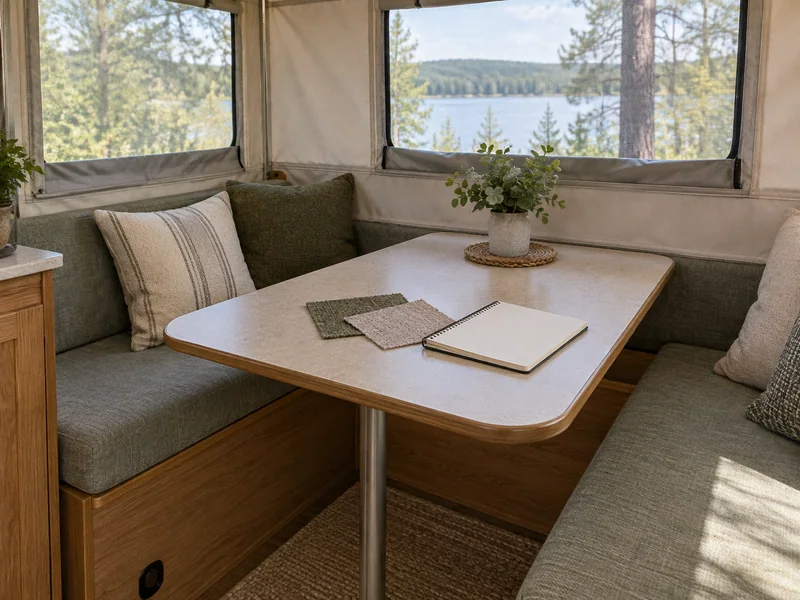
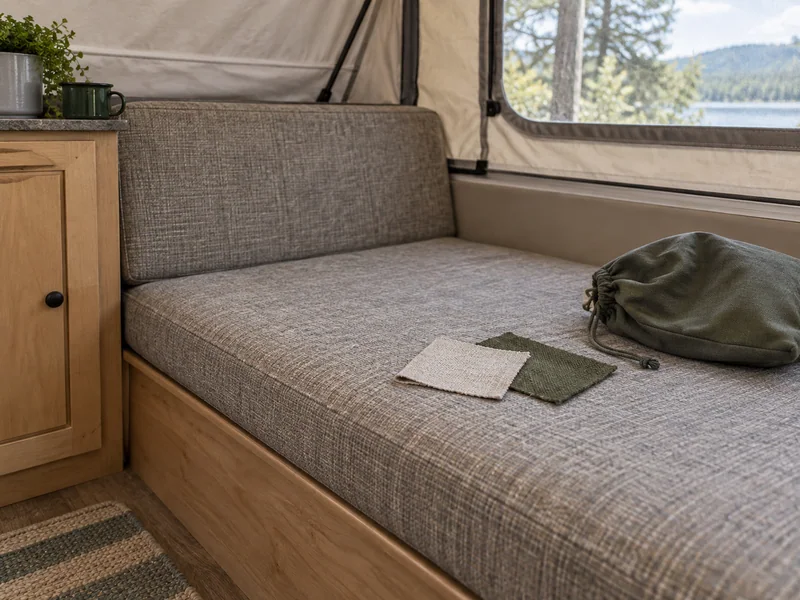
AI-generated illustration: A pop-up dinette illustrates soft-goods planning within an intact interior, without representing a completed renovation.
Plan a pop-up renovation in both its open camping state and closed travel state. Identify the trailer, lift system and tent material, resolve condition questions before adding finishes, and keep roof closure, wet packing, bunk supports and stored equipment in the work scope. Use written quotes and a closure review rather than copying another camper's repair details.
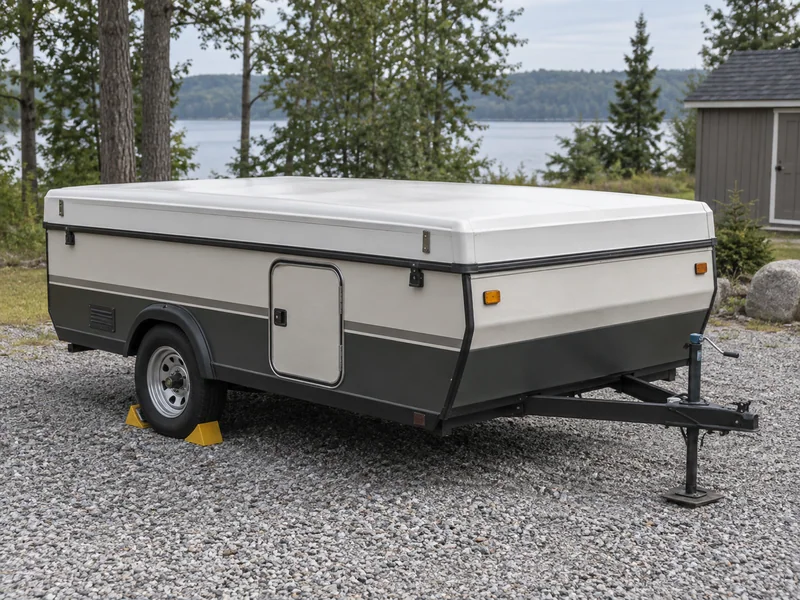
A pop-up camper has to work in two shapes. At camp, the roof is raised, bunks are extended and tent fabric is tensioned as designed. For travel, those parts fold into a much smaller envelope. A renovation that improves the open interior can still fail if added cushions, cabinets or stored equipment interfere with closure.
Begin with a condition and movement record for your actual trailer. Identify the lift system, tent material, bunk supports and original setup procedure. Then define improvements that preserve both the camping arrangement and the required travel arrangement.
This researched guide helps scope a project. It does not provide structural repairs, lift adjustments, a canvas replacement pattern, measured costs or a completed before-and-after example. The practical work here is choosing what to investigate, what to quote and what the finished project must demonstrate.
Identify the trailer and its fitted systems
Record the make, model, model year and VIN. Add separate model or serial numbers for the lift or winch, appliances and any aftermarket equipment. A previous owner’s modification may mean the trailer no longer matches its original brochure.
Collect the correct owner’s manual, component instructions and available service records. Forest River’s current owner-resource page directs owners to interactive manuals, while its component library separates equipment documentation. Both matter when an appliance or lift component has its own requirements.
An old manual can explain the questions to ask, but it cannot identify an unfamiliar trailer for you. The legacy Rockwood and Flagstaff documents cited below are model-era examples. Confirm their applicability with the manufacturer or a suitable service provider before using any operating or maintenance instruction.
Check vehicle and equipment recall information as part of the history review. NHTSA’s recall search has limitations for older and specialty vehicles, so keep manufacturer inquiries and service records alongside search results. None of these records substitutes for inspecting a used camper’s present condition.
Start with condition, then appearance
Look from safely accessible positions and record what is visible. Photograph stains with their location, identify damaged fabric sections and note whether doors, bunks or the roof behave as the manual describes. Do not force movement to make a renovation measurement possible.
If support, lifting or structural condition is uncertain, have it assessed before operating or working beneath the affected assembly. A roof that is difficult to move is not a reason to fit a stronger motor or change cable tension from a generic online instruction.
| Area | Observation to record | Why it changes the project | Next decision |
|---|---|---|---|
| Roof and ceiling | Stains, damaged finish, unknown repairs, added equipment | The cause may affect more than appearance | Obtain appropriate condition and loading assessment |
| Lift system and supports | Identified system, service history, abnormal operation | Renovation access depends on proper support and movement | Resolve operation before interior work |
| Tent fabric and seams | Material, damaged panel, zipper or attachment condition | Repair and replacement depend on the actual fabric and pattern | Seek material-specific advice and a precise quote |
| Bunk ends and supports | Correct fitted parts and visible concerns | Sleeping support cannot be inferred from a fresh mattress | Confirm components and condition |
| Floor and lower cabinets | Visible staining, deterioration or previous alterations | New covering could conceal an unresolved problem | Assess before covering or fastening |
| Fold-down galley or furniture | Movement path and stored position | Added thickness or objects can obstruct closure | Preserve the full original operating sequence |
| Utilities and appliances | Model, condition and service record | A cosmetic project may expose system work | Separate qualified service from decoration |
Describe observations neutrally. “Dark mark beside the front roof corner after rain” is more useful to a technician than “the canvas needs waterproofing” when the source has not been established. A wet surface, a leaking seam and concealed deterioration are different findings.
Make a map of the closed trailer
The closed arrangement deserves its own drawing. Mark where the door, galley, tent bows, cushions, curtains and loose equipment stow. Include every item that moves during the manufacturer’s normal takedown procedure.
The legacy Flagstaff tent-camper manual illustrates how specific that procedure can be: on models with its ceiling-mounted folding clothes hanger, clothes and hangers must be removed and the bar returned to its stored position. That detail is not a rule for every trailer. It shows why a seemingly simple hanging-storage addition needs a closed-state check.
Do not use closing force as a fit test. If a new cushion, bag or trim piece interferes, stop and identify the obstruction. A roof latch should not be used to compress a new packing arrangement into compliance.
Keep a baseline record before changing anything. Once the trailer has been confirmed safe to operate, record the normal empty and packed closure arrangements according to its manual. Your baseline should identify the contents, not merely show a roof that happens to be down.
Choose improvements that fit both states
Removable soft goods and clear storage routines are often easier to scope than changes to the roof, lift or fixed cabinetry. They still need suitable materials, proper fit and a place during travel.
| Proposed improvement | Benefit when open | Question when closed | Work to include in the scope |
|---|---|---|---|
| New cushion covers | Refreshes a worn seating surface | Does the complete cushion stow and fit as required? | Pattern, fabric care, fastenings and fitted dimensions |
| Different mattress or topper | Changes the sleeping surface | Is its thickness and weight compatible with the bunk and closed arrangement? | Actual measurements and manufacturer confirmation where needed |
| Replacement curtains | Restores privacy or damaged fabric | Do folds or attachment parts enter moving areas? | Material suitability, track compatibility and stored position |
| Removable clothing pouches | Makes belongings easier to find | Where do filled pouches travel? | Same-inventory packing rehearsal |
| Cabinet finish refresh | Changes appearance of sound surfaces | Do coatings or new pulls affect closure? | Surface identification, preparation and cure conditions |
| Floor-covering renewal | Addresses a worn walking surface | Does added thickness obstruct galley, door or furniture movement? | Substrate assessment, edges and access requirements |
| Canvas repair or replacement | Addresses identified fabric defects | Does it fold, attach and tension correctly? | Exact model pattern, material, installation and verification |
| Roof or lift-related work | Addresses a diagnosed fault or approved equipment change | Can the complete system operate within its requirements? | Qualified assessment and vehicle-specific repair design |
Do not assume an added topper can remain on the bunk for travel. Ask where it will go if the correct closed arrangement requires its removal. Its alternate location must also accommodate the rest of the load.
Keep reusable organizing changes reversible while you learn the routine. The RV storage overview helps assign belongings by when they are needed. In a pop-up, add a second question to every item: where does it go before the roof lowers?
Treat tent material as an identified component
The everyday word canvas can refer to different fabrics and coated materials. Record what the manufacturer calls yours and whether the windows, seams and panels need different care. A cleaner suitable for a removable cushion is not automatically suitable for a vinyl window or a coated tent wall.
The legacy Rockwood tent-camper manual cautions against solvents and abrasive cleaning on its vinyl tent material. It also addresses drying after moisture exposure. Those narrow examples are useful when writing a care or replacement brief; they should not be expanded into a universal cleaning mixture or seam-treatment schedule.
For a replacement quote, provide the trailer identification, photographs of attachments and the particular damaged sections. Ask whether the quote covers an individual panel or the complete tent assembly, what measurements or original parts are required, and how final fit is verified. Confirm lead time before removing usable fabric.
If a supplier requests the old assembly as a pattern, establish how the open trailer will be protected and stored while it is away. Weather exposure during a renovation belongs in the project plan, not in an improvised response after the fabric has been removed.
Plan for a wet departure
A camper can leave a campsite damp even when the weather has improved. Decide before the trip where it can be reopened and dried if closing wet becomes unavoidable under its instructions. Include room for the raised roof and extended bunks, access permission and the time you can return to it.
The Rockwood legacy manual says to let wet tent material dry completely before closing and to protect cushions and drapes if it must be closed wet. It calls for prompt ventilation and drying after moisture exposure. Use the procedure and restrictions for your model; no fixed number of safe wet-storage hours is established here.
Keep a visible reminder with the travel checklist when an item is packed wet. Record what is damp and what must be reopened. Do not mark the storage job complete simply because the roof is latched and the trailer fits in the driveway.
Separate damp outdoor clothing and gear from dry bedding during the return process. The bathroom storage guide covers towels and wash items, while the RV moisture log helps document recurring dampness inside the vehicle. Neither replaces tent-material instructions.
Be specific about roof coatings and added equipment
Identify the roof construction, existing finish and previous sealants before requesting work. A product sold for RV roofs is not necessarily compatible with every membrane, molded roof or accessory.
Dicor’s Self-Leveling Ultra Sealant information distinguishes substrate and primer requirements. Use that as a reminder to obtain an exact product-and-surface specification from the repair provider. This guide does not prescribe a sealant or a coating system for an unidentified pop-up roof.
Roof-mounted additions affect more than storage capacity. Their compatibility must be assessed with the roof, lift system, mounting arrangement and closed trailer. Do not infer an allowable accessory load from the sleeping capacity of the bunks or the tow vehicle’s maximum tow rating.
Price the complete phase
Use the camper remodel budgeting method for quote comparisons, then add the pop-up-specific dependencies below. Keep quoted amounts, allowances and unresolved costs separate.
| Project phase | Price source to obtain | Dependency | Completion evidence |
|---|---|---|---|
| Condition and operating assessment | Written inspection or service scope | Trailer and component identification | Findings and unresolved items recorded |
| Required repairs | Itemized repair quote | Assessment completed | Agreed system checks and service record |
| Tent or soft-goods work | Exact-pattern supplier or installer quote | Material, dimensions and storage arrangement | Fit, care information and closed-state review |
| Cosmetic finishes | Product and labor sources with dates | Dry, suitable surfaces and completed repairs | Finish condition and required cure completed |
| Packing and closure review | Time and access you arrange | All finished items aboard | Normal manual-directed closure without interference |
Do not buy decorative materials before an unresolved condition issue has a defined scope. If the repair budget changes, it is easier to postpone new covers than to reverse a partially installed floor.
Keep an open-and-closed project card
- Trailer, lift and tent material identified: ________
- Applicable manuals and service records: ________
- Condition findings that must be resolved first: ________
- Open-state problem the project solves: ________
- Closed-state location of every changed item: ________
- Weight, attachment and movement questions: ________
- Quote scope, date and exclusions: ________
- Place to reopen and dry after a wet trip: ________
- Final operating and closure review: ________
Retain this card with material care instructions and repair records. A useful pop-up renovation improves camp life while preserving the complete transition back to a correctly closed, loaded trailer.
Sources & further reading
Use these original sources for the full context and the latest guidance.
- Forest River: Owner resources and interactive manuals (opens in a new tab)
- Forest River: Rockwood tent camper owner's manual, legacy document (opens in a new tab)
- Forest River: Flagstaff tent camper owner's manual, legacy document (opens in a new tab)
- Forest River: Component manuals (opens in a new tab)
- NHTSA: Vehicle and equipment recall search (opens in a new tab)
- Dicor: Self-Leveling Ultra Sealant substrate requirements (opens in a new tab)
Prepared with AI assistance. Read our editorial approach.
This is a researched planning guide, not a report of a hands-on product test.
Last updated .